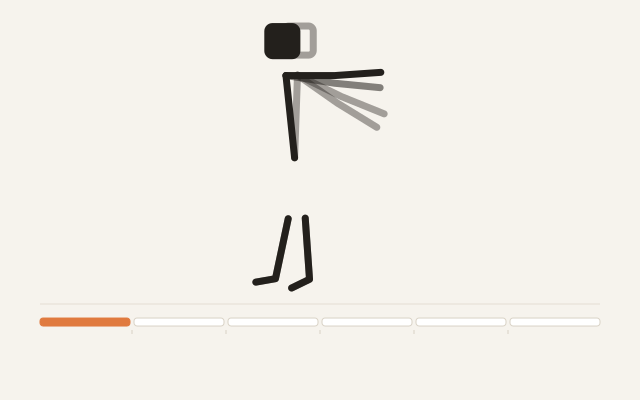
A wall gives you something a floor cannot: instant feedback. If your mid-back does not move, the wall will not let you pretend otherwise, because your lower back has to lift off it. This sequence uses that feedback to open the front of the chest and the front of the shoulders — the two places that a day of typing pulls forward and holds there.
The wall is the teacher
Stand with the back of the head, the upper back and the tailbone touching the wall, and try to lift the arms overhead without letting the lower back arch away. Most people cannot do it on the first attempt, and the place where contact is lost tells you exactly where the restriction is. Use that reading rather than chasing a range that the wall is not going to give you.
Head position is the whole thing
These steps fail quietly when the head goes forward, because a forward head makes the chest look open while the neck does all the work:
- In every step, the back of the skull should stay in light contact with the wall. If the chin lifts, you have lost it.
- Nod gently to bring the chin toward the throat before the arms move, then keep that position.
- If the head cannot touch the wall without a struggle, put a folded towel behind it — working with a towel is not cheating, it is the same exercise at a range you can actually hold.
What the stretch should feel like
The target is a broad, warm opening across the collarbones and the front of the shoulders. If the sensation is a sharp pull at the front of one shoulder joint, or a nerve-like tingle running into the hand, the arm has gone past the joint range and the shoulder is jamming. Bring the arms lower, widen them, or move the hands down the wall until the feeling returns to the chest and stays there.
Questions about this sequence
Why does my lower back arch off the wall?
Because the mid-back is not extending, so the lower back supplies the movement instead. Bend the knees slightly, tuck the tailbone a little, and take the arms lower. The height the hands reach is not the goal — keeping the ribs down and the back in contact is.
Can I do this in a doorway instead?
The doorway version opens the chest in a different way, from a deeper, more fixed position. Use the wall when you want to control the range, and the doorway when you want a longer hold with a bigger stretch. Both are in the library; the wall one is the gentler starting point.
My shoulders click overhead — should I stop?
A dry click with no pain is common and is usually not a reason to stop. Pain, a pinch at the top of the shoulder, or a sense that the arm is about to give way is a reason to stop and get the shoulder looked at. Painless noise on its own is not.

5 min6 stepsGentleNeck & shoulders
The shoulder blade is a bone that floats on the back of the ribcage and is supposed to slide upward, downward and around it. A day of typing holds it in one place for hours, and the muscles that normally move it stop being asked. This sequence spends five minutes asking, in a small range, with almost no load — which is exactly what a shoulder that has been still all day can accept.

5 min6 stepsGentleThoracic spine
Everything here happens without standing up. The spine is moved through flexion, side bending and rotation in the order that a stiff back tolerates them, and the whole sequence fits in the gap between two meetings. It does not replace a floor practice, but five seated minutes done three times a day beats thirty floor minutes done once and then abandoned.

5 min6 stepsGentleCalves & ankles
Two muscles run down the back of the lower leg and they need different angles: the gastrocnemius crosses the knee, so it only lengthens with a straight leg; the soleus sits below the knee, so it only lets go when the knee is bent. This ladder does both, in that order, on both sides, and finishes by reminding the ankle that it can move in more than one direction.