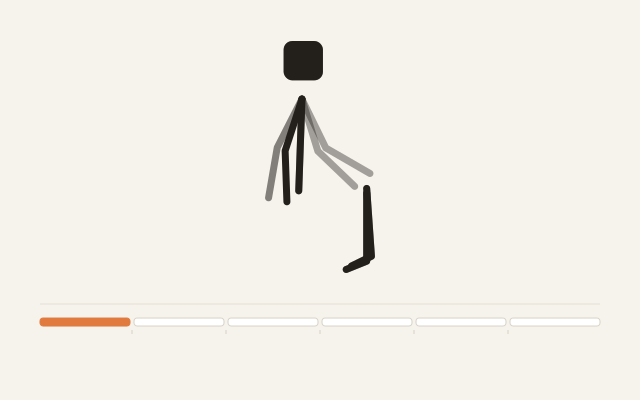
The shoulder blade is a bone that floats on the back of the ribcage and is supposed to slide upward, downward and around it. A day of typing holds it in one place for hours, and the muscles that normally move it stop being asked. This sequence spends five minutes asking, in a small range, with almost no load — which is exactly what a shoulder that has been still all day can accept.
Slow shoulder rolls
Holding · both sides
5:00
1 / 6
Six rolls each way, as slowly as you can stand. Let the shoulder blade lead the movement rather than the arm.
6 steps · 5 min
Before you start General movement information, not medical advice. Shoulder pain that wakes you at night, or an arm that feels weak or numb, needs assessment before exercise.
Step table
Step
Hold
Side
What you should feel
1. Slow shoulder rolls
45s + 5s
both sides
Six rolls each way, as slowly as you can stand. Let the shoulder blade lead the movement rather than the arm.
2. Shoulder blade slide
40s + 10s
both sides
Fingertips on the floor in front of you, arms straight, and slide the shoulder blades up toward the ears and back down. Ten times, small.
3. Wall angel
45s + 5s
both sides
Back and head on the wall, arms sliding up and down. Only as high as you can go without the lower back lifting.
4. Band pull apart
40s + 10s
both sides
Lightest band, arms straight ahead, pull the hands apart and squeeze the blades together for two seconds. Twelve slow repetitions.
5. Cross body arm
45s + 5s
left side
Left arm across the chest, right hand above the elbow drawing it in. Keep the left shoulder pressed down — the shoulder blade, not the joint, is what should move.
6. Upper trap lean
35s + 15s
both sides
Sit tall, hold the edge of the mat with one hand, and tilt the head away. That anchoring hand is what turns a neck stretch into a neck-and-shoulder-blade stretch.
How to run this sequence
Small and often beats big and rare
Shoulder range responds to frequency more than to intensity. Five minutes done three times a day will do more for a stiff shoulder than one forty-minute session at the weekend, partly because the tissue never gets the chance to set. If you only have time for one thing, do the blade slide in step two — it is the single most direct way to remind the shoulder blade that it can move upward as well as around.
What the band is actually for
The band is here to add a small amount of resistance in the direction the shoulder blade is weakest, which is usually backward and downward. Two rules:
Use the lightest band you own. The point is to give the muscle a job, not to make it tired.
Keep the motion slow and stop before the shoulder starts to shrug upward. Shrugging is how the body cheats a movement it cannot yet do cleanly.
If a band is not available, the same steps work with no resistance at all — you simply lose the feedback, not the movement.
Where this fits with neck work
Neck and shoulder blade are one system: the upper trapezius attaches to both. Stretching the neck while the shoulder blade stays stiff gives temporary relief and no change, because the muscle that is actually tight is being pulled on from one end only. Do the blade work first, then the neck steps — it is a different five minutes from the neck routine in the library, and the two are meant to be run back to back on a bad day.
Questions about this sequence
My shoulder blade clicks when I move it — is that bad?
A painless scrape or click as the blade moves over the ribs is very common and usually the muscle or the tissue over the bone. It is only worth attention if it comes with pain, or if it appears alongside a loss of range that has come on recently.
Should I feel this in my upper traps?
You will feel something there, but the effort should feel like it is coming from under the shoulder blade, not from the top of the shoulder. If the top of the shoulder is doing all the work, lower the arms and make the movement smaller.
Can I do this standing up?
Yes — steps two, four and five work standing, and step two works particularly well against a wall. The floor steps are easier to do without compensating, which is why the sequence is written that way, but standing is a fine substitute when there is no space to lie down.
A wall gives you something a floor cannot: instant feedback. If your mid-back does not move, the wall will not let you pretend otherwise, because your lower back has to lift off it. This sequence uses that feedback to open the front of the chest and the front of the shoulders — the two places that a day of typing pulls forward and holds there.
Everything here happens without standing up. The spine is moved through flexion, side bending and rotation in the order that a stiff back tolerates them, and the whole sequence fits in the gap between two meetings. It does not replace a floor practice, but five seated minutes done three times a day beats thirty floor minutes done once and then abandoned.
Two muscles run down the back of the lower leg and they need different angles: the gastrocnemius crosses the knee, so it only lengthens with a straight leg; the soleus sits below the knee, so it only lets go when the knee is bent. This ladder does both, in that order, on both sides, and finishes by reminding the ankle that it can move in more than one direction.