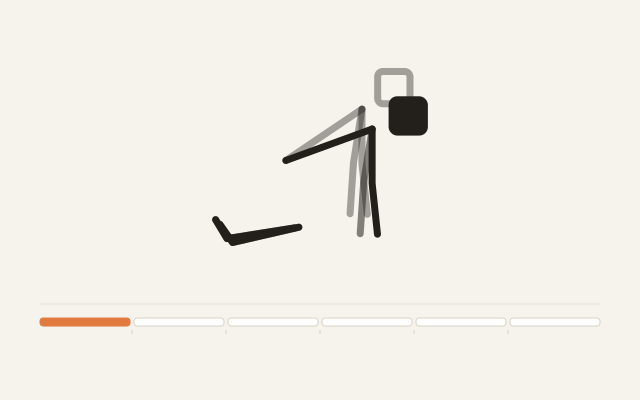
Everything here happens without standing up. The spine is moved through flexion, side bending and rotation in the order that a stiff back tolerates them, and the whole sequence fits in the gap between two meetings. It does not replace a floor practice, but five seated minutes done three times a day beats thirty floor minutes done once and then abandoned.
Seated cat and cow
Holding · both sides
5:00
1 / 6
Hands on the knees. Round and arch slowly, six rounds, and let the movement start at the pelvis rather than the shoulders.
6 steps · 5 min
Before you start General movement information, not medical advice. A mid-back that is painful at rest, or pain that travels around the ribs into the chest, needs medical assessment before any of this.
Step table
Step
Hold
Side
What you should feel
1. Seated cat and cow
45s + 5s
both sides
Hands on the knees. Round and arch slowly, six rounds, and let the movement start at the pelvis rather than the shoulders.
2. Seated spine wave
40s + 10s
both sides
Roll down one vertebra at a time until the ribs are over the belly, then stack back up from the base. Slower than feels natural.
3. Seated side bend
45s + 5s
left side
Right hand on the right ribs, left arm overhead, lean left. The right ribs should push into your hand — if they do not, you are dropping the shoulder instead of bending.
4. Seated side bend
40s + 10s
right side
Same to the right, left hand on the left ribs. Keep both sit bones on the seat or the bend turns into a hip shift.
5. Seated rotation
45s + 5s
right side
Hands crossed on the chest, hips facing forward, turn from the ribs. Equal to both sides — most people find one direction has half the range.
6. Hands on ribs breathing
35s + 15s
both sides
Wrap the hands around the lower ribs and breathe into them for six slow breaths, feeling the ribs widen sideways rather than the belly push out.
How to run this sequence
Sit on the front half of the chair
Almost every seated stretch fails for the same reason: the pelvis is rolled back and the chair back is doing the work of holding you up. Sit forward until the sit bones are the only thing on the seat, feet flat, knees level with the hips or slightly below. If the knees are higher than the hips, fold something under you — a jumper, a ream of paper — because a tucked pelvis turns every movement below into a lower-back movement.
The order is deliberate
Flexion and extension first, then side bending, then rotation last. Rotation is the movement a stiff mid-back guards hardest, and asking for it before the segments have been moved forward and back is how people end up with a catch in the ribs. In this sequence:
Steps one and two wave the spine forward and back, small and continuous.
Step three bends to each side with one hand on the ribs so you can feel whether the ribs actually move.
Steps four and five rotate, first with hands crossed on the chest, then reaching across with one arm.
Step six puts a hand on the ribs and breathes, which is a reset rather than a stretch.
What to do if you are in an open office
Every step here is small enough to do at a desk without anyone noticing. If self-consciousness is the thing stopping you, the honest trade is this: a two-minute version of steps one and four, repeated hourly, does most of the work. Do the full five when you can, the small version when you cannot, and stop treating the full sequence as the only version that counts.
Questions about this sequence
Does a chair make it less effective?
For the mid-back, no. The thoracic spine is not loaded by body weight in the way the hips or hamstrings are, so what matters is the range you move it through, not whether you are standing. The seated version loses traction and gravity-assisted lengthening, which is why a floor routine is still worth having.
My chair has arms — does that matter?
It rules out the side bend as written, but you can do it leaning away from one armrest with the arm hanging into the gap. If both arms block the movement, stand up for that one step and sit back down. Ten seconds of standing is a smaller interruption than skipping the step.
How many times a day can I run this?
Three is a good ceiling for the full sequence. The first two steps are gentle enough to repeat more often — a slow wave forward and back, ten times, is a reasonable thing to do every hour without thinking about it.
The shoulder blade is a bone that floats on the back of the ribcage and is supposed to slide upward, downward and around it. A day of typing holds it in one place for hours, and the muscles that normally move it stop being asked. This sequence spends five minutes asking, in a small range, with almost no load — which is exactly what a shoulder that has been still all day can accept.
Nothing here is meant to change your range. This sequence is about the thing that actually decides how you sleep: whether the body is still holding the day in its back and hips when you lie down. Every step is slow, every step ends lying or sitting, and the last one is chosen so that getting into bed afterwards is a two-second movement rather than a project.
A wall gives you something a floor cannot: instant feedback. If your mid-back does not move, the wall will not let you pretend otherwise, because your lower back has to lift off it. This sequence uses that feedback to open the front of the chest and the front of the shoulders — the two places that a day of typing pulls forward and holds there.