Skip to the player
Unkink
timed stretching, cued by the second

Fifteen Minute Bedtime Spine and Hip Release

15 min10 stepsGentleThoracic spineHipsPublished 14 Sep 2026

Nothing here is meant to change your range. This sequence is about the thing that actually decides how you sleep: whether the body is still holding the day in its back and hips when you lie down. Every step is slow, every step ends lying or sitting, and the last one is chosen so that getting into bed afterwards is a two-second movement rather than a project.

Cat and cow
Cat and cow
Holding · both sides
15:00
1 / 10
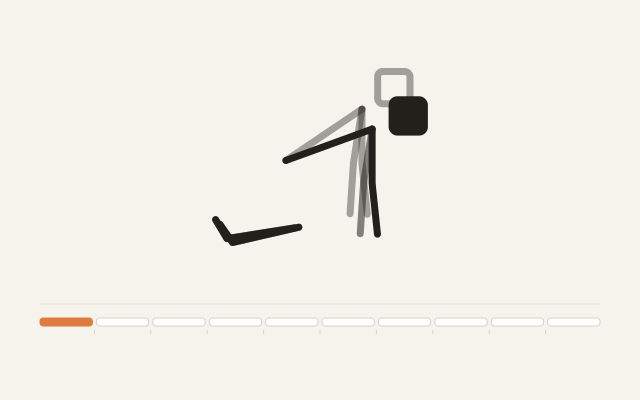
Six slow rounds, matched to the breath. This is the only warm-up the sequence gets and it is enough.
10 steps · 15 min

Before you start
General movement information, not medical advice. Persistent insomnia, or pain that reliably wakes you at night, needs medical assessment rather than a stretching routine.
Step table
StepHoldSideWhat you should feel
1. Cat and cow85s + 5sboth sidesSix slow rounds, matched to the breath. This is the only warm-up the sequence gets and it is enough.
2. Thread the needle80s + 10sleft sideLeft arm under, shoulder and temple down, five breaths. Let the weight of the body do the work; there is nothing to push here.
3. Thread the needle75s + 15sright sideRight side. If the neck is doing the work, slide something thin under the head and try again.
4. Child's pose80s + 10sboth sidesSit back to the heels, arms forward, forehead down. This is the widest, least specific thing in the sequence and the one most people want to stay in.
5. Butterfly85s + 5sboth sidesSoles together, spine long, and let the knees fall. Do not push them down — put cushions under them and let gravity work while you breathe.
6. Figure four80s + 10sright sideRight ankle over the left knee, reach through and draw the legs in. A wide stretch across the right glute, nothing sharp at the knee.
7. Figure four75s + 15sleft sideLeft ankle over the right knee. Keep the head and shoulders on the floor for the whole hold — lifting the head to look at the legs is how this stops working.
8. Supine twist80s + 10sright sideKnees to the right, arms out, left shoulder heavy. Five slow breaths, then let the legs come back through centre on their own.
9. Supine knee hug85s + 5sboth sidesBoth knees in, tailbone heavy, rock very slowly side to side. Nothing to achieve — this is the step that tells the lower back the day is over.
10. Supine full stretch80s + 10sboth sidesArms overhead, legs long, stretch everything for five seconds then let go completely. Two rounds, then stay lying still and roll straight into bed.

How to run this sequence

Why the spine and hips and not the whole body

These are the two areas where a day of sitting and standing leaves the most residual tone, and they are also the two areas that make lying down uncomfortable: a stiff mid-back means no position feels supported, and tight hips mean the legs cannot rest flat. Working them in that order means the last few steps can be done lying down, which is the state you are trying to arrive at.

Slower than a daytime session

Three things are different at night, and all three are on purpose:

  • Holds are longer and the movements between them are slower — the bell is there to stop you rushing, not to keep you on pace.
  • Nothing is loaded. There is no lunge, no squat and no standing balance step, because the goal is to reduce tone rather than to produce it.
  • The sequence ends lying down. If you finish it and immediately have to walk, stand and climb stairs, you have partly undone the last two steps.

If you cannot switch off

A slow sequence before bed does more for sleep than most people expect, but it is not a substitute for treating insomnia. If you are lying awake for more than twenty minutes most nights, the useful change is usually in what happens in the two hours before, not in the ten minutes of stretching. Keep this sequence anyway — a body that is not holding tension is a better starting point for the version of the evening that actually works.

Questions about this sequence

Will this make me sleepy enough to skip?

Sometimes, which is fine. If you fall asleep on the mat, you have got most of the benefit already. Put the mat where it is not in the way and do not treat the last step as mandatory.

Can I do it in bed instead?

The two supine steps work fine in bed and the seated ones work if you have a firm mattress. The floor steps — the child pose, the thread the needle — do not, because a soft surface means the movement goes into the mattress. A hybrid works: floor for the first half, bed for the last three steps.

Should I do this on a hard day after training?

Yes, it is one of the better choices after a hard session, precisely because nothing is loaded. Keep the ranges smaller than usual and let the long holds do the work. If a muscle is sore to touch, leave that area alone and keep the rest.

Other sequences that pair well

Twenty Minute Deep Hip Opener — Preview rail

Twenty Minute Deep Hip Opener

20 min12 stepsDeepHips

This is the longest and deepest sequence in the library and it is built for people who already move regularly. Five positions are held for around ninety seconds each, twice, with a supported counter-pose between them. Nothing here is forced, but the holds are long enough that the nervous system has to make an actual decision to let go — which is the difference between this and a ten-minute routine you can do while thinking about something else.

Ten Minute Standing Hip Circles — Preview rail

Ten Minute Standing Hip Circles

10 min8 stepsGentleHips

This is the sequence for the day you cannot lie down. Every step happens on your feet, which means the hip has to move while also holding you up — a different job from the same movement on a mat, and the one your hips actually do all day. The first half circles the joint through its full available range, the second half loads it at the end of that range.

Five Minute Seated Spine Wave — Preview rail

Five Minute Seated Spine Wave

5 min6 stepsGentleThoracic spine

Everything here happens without standing up. The spine is moved through flexion, side bending and rotation in the order that a stiff back tolerates them, and the whole sequence fits in the gap between two meetings. It does not replace a floor practice, but five seated minutes done three times a day beats thirty floor minutes done once and then abandoned.