Skip to the player
Unkink
timed stretching, cued by the second

Twenty Minute Deep Hip Opener

20 min12 stepsDeepHipsPublished 18 Sep 2026

This is the longest and deepest sequence in the library and it is built for people who already move regularly. Five positions are held for around ninety seconds each, twice, with a supported counter-pose between them. Nothing here is forced, but the holds are long enough that the nervous system has to make an actual decision to let go — which is the difference between this and a ten-minute routine you can do while thinking about something else.

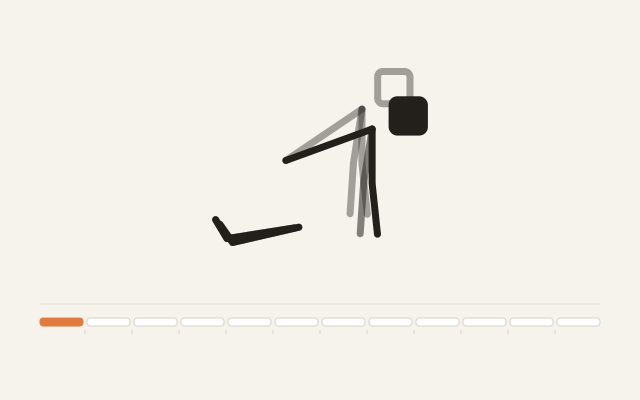
Cat and cow
Cat and cow
Holding · both sides
20:00
1 / 12
Eight slow rounds. Do not shorten this — the whole point of the next twenty minutes is that the tissue arrives warm.
12 steps · 20 min

Before you start
General movement information, not medical advice. Long end-range hip holds are not appropriate with a labral tear, hip impingement that has been diagnosed, or a joint replacement. Clear it with a clinician first.
Step table
StepHoldSideWhat you should feel
1. Cat and cow95s + 5sboth sidesEight slow rounds. Do not shorten this — the whole point of the next twenty minutes is that the tissue arrives warm.
2. 90/90 hip switch90s + 10sboth sidesBoth knees at right angles, sitting tall on the brick. Switch sides slowly, five times, letting the knees travel through the middle rather than hopping across.
3. Low lunge with brick85s + 15sleft sideRight knee down, hands on the brick. Tuck the tailbone, then squeeze the right glute at 30% — the front of the hip only releases when the back of it works.
4. Couch stretch90s + 10sright sideBack foot up against the wall, knee down. This is the deepest front-of-hip position in the library; if the lower back arches, you have gone too far back.
5. Pigeon85s + 15sleft sideLeft shin across, hips square, fold only as far as the breath stays slow. Put the brick under the left hip if it is hanging in the air.
6. Glute bridge90s + 10sboth sidesCounter-pose. Feet down, lift the hips five times slowly, then hold the top for five breaths. This is what tells the hip it can still work after being stretched.
7. Frog rock85s + 15sboth sidesKnees wide, feet wide, weight back on the hands or forearms. Wide and shallow beats narrow and deep — the inner thigh is a small range, not a big one.
8. Butterfly, folded90s + 10sboth sidesSoles together, fold forward from the hips with a long spine. Cushions under the knees stop them from being the thing that ends the hold.
9. Deep squat85s + 15sboth sidesFeet slightly wider than the hips, heels down or on a folded mat, elbows inside the knees. Sit at the bottom and breathe; the whole point is that the hips are loaded while open.
10. 90/90, second round90s + 10sboth sidesSecond round. Compare the two sides now — the difference you feel is the honest one, because both have had the same twenty minutes.
11. Frog rock, second round85s + 15sboth sidesSecond round, slightly wider or slightly deeper than before. One small increase, not a big one.
12. Supine twist to finish90s + 10sleft sideKnees to the left, right shoulder heavy, five slow breaths. Then lie flat and stay there for a minute before you get up — the joint needs the rest more than it needs the next thing.

How to run this sequence

The counter-pose is not optional

Long hip holds leave the joint compressed and the surrounding tissue switched on. The supine knee hug and the bridge appear twice each in this sequence for that reason: they decompress the joint and re-establish that the hip can be moved without being stretched. If you are short on time and want to trim, cut a second-round hold rather than a counter-pose.

Depth comes from orientation, not from pushing

In every step here, the amount of stretch is set by where the pelvis is pointing, not by how hard you lean:

  • Square the pelvis first, then go deeper. A hip that has rotated out to escape is not stretching anymore.
  • Use the brick under the hands, the hip or the knee — supporting yourself is what makes a ninety-second hold possible, and a supported long hold beats an unsupported short one every time.
  • If you cannot breathe slowly in a position, come out of it by a third. Depth that costs you the breath is depth you cannot keep and therefore will not adapt to.

Signals to come out immediately

Three sensations mean the position is wrong rather than deep: a pinch at the front of the hip, tingling or numbness anywhere in the leg, and a sharp catch at the knee. All three are the joint or a nerve, not the muscle, and none of them improve with more time. Come out, shake the leg, and rebuild the position with the pelvis more square and the range smaller. The dull, wide ache in the glute that takes twenty seconds to arrive is the signal you are actually after.

Questions about this sequence

Is it normal to feel shaky afterwards?

Mild shaking or a feeling of heaviness is common after long holds and is not a problem. It usually passes in a few minutes of walking. If it is accompanied by a sense that the leg will not take your weight, stop for the day and get it checked if it repeats.

How often should I do the twenty-minute version?

Once or twice a week is plenty. The deep sequence is a stimulus, not maintenance — the ten-minute hip routine is the one to do most days. Doing this daily tends to produce stiffness rather than range, because there is not enough recovery time between sessions.

Can I use this to work towards splits?

It covers the front of the hip and the glutes, which are two of the four things splits need. It does not cover the hamstrings in a lengthened position or the inner thigh, so pair it with the hamstring ladder and a butterfly-based sequence. Front-of-hip range is also limited by the joint shape, which no amount of stretching changes.

Other sequences that pair well

Fifteen Minute Bedtime Spine and Hip Release — Preview rail

Fifteen Minute Bedtime Spine and Hip Release

15 min10 stepsGentleThoracic spineHips

Nothing here is meant to change your range. This sequence is about the thing that actually decides how you sleep: whether the body is still holding the day in its back and hips when you lie down. Every step is slow, every step ends lying or sitting, and the last one is chosen so that getting into bed afterwards is a two-second movement rather than a project.

Ten Minute Standing Hip Circles — Preview rail

Ten Minute Standing Hip Circles

10 min8 stepsGentleHips

This is the sequence for the day you cannot lie down. Every step happens on your feet, which means the hip has to move while also holding you up — a different job from the same movement on a mat, and the one your hips actually do all day. The first half circles the joint through its full available range, the second half loads it at the end of that range.

Ten Minute Hip Flexor Unwind — Preview rail

Ten Minute Hip Flexor Unwind

10 min8 stepsStandardHips

Sitting does not shorten the hip flexors so much as teach them to stay switched on. This sequence alternates the two things that actually change that: a long, supported lengthening of the front of the hip (the lunges), and an active squeeze of the opposite glute, which is what tells the hip to let go in the first place. The last two steps are rotations, because a hip that can lengthen but not turn is still a hip that will complain.