Skip to the player
Unkink
timed stretching, cued by the second

Ten Minute Standing Hip Circles

10 min8 stepsGentleHipsPublished 2 Sep 2026

This is the sequence for the day you cannot lie down. Every step happens on your feet, which means the hip has to move while also holding you up — a different job from the same movement on a mat, and the one your hips actually do all day. The first half circles the joint through its full available range, the second half loads it at the end of that range.

Standing hip circle
Standing hip circle
Holding · left side
10:00
1 / 8
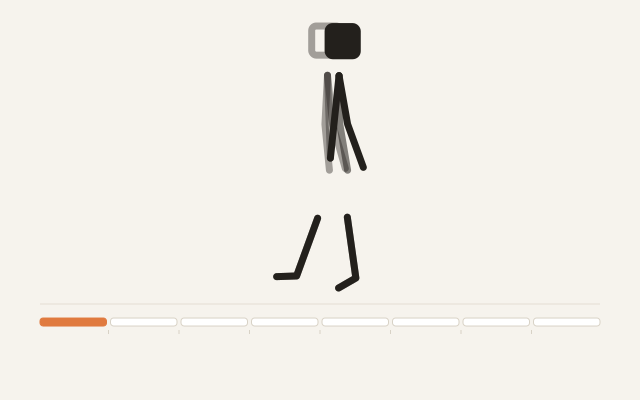
Hand on a wall, weight on the right leg. Draw ten slow circles with the left knee — forward, out, back, in — and keep the pelvis perfectly still.
8 steps · 10 min

Before you start
General movement information, not medical advice. If a circle reproduces a sharp catch, a locking sensation or pain that lingers after you stop, stop and have the hip assessed.
Step table
StepHoldSideWhat you should feel
1. Standing hip circle70s + 5sleft sideHand on a wall, weight on the right leg. Draw ten slow circles with the left knee — forward, out, back, in — and keep the pelvis perfectly still.
2. Standing hip circle65s + 10sright sideTen circles on the right, then reverse the direction on both sides. The backward half of the circle is where the range usually is not.
3. Standing lunge70s + 5sleft sideLeft foot forward, back heel lifted, sink straight down. Tuck the tailbone and you will feel this at the front of the right hip instead of the right knee.
4. Standing lunge65s + 10sright sideRight foot forward. Step a little wider than feels natural — a narrow stance puts the front knee in front of the toes and the stretch disappears.
5. Standing wide fold70s + 5sboth sidesFeet wide, toes slightly in, fold forward with soft knees and hands on the floor or on a chair seat. Rock the weight slowly from one foot to the other.
6. Standing reach up65s + 10sboth sidesStand tall and reach both hands overhead, then side bend slowly left and right. This is the counter-pose to the fold — do not skip it and go straight to sitting down.
7. Standing forward fold70s + 5sboth sidesFeet hip width, knees bent, head heavy. Let the neck hang completely — this is the only step in the sequence that touches the back line at all.
8. Slow shoulder rolls65s + 10sboth sidesFinish standing, five rolls each direction, breathing out on the way down. It closes the sequence and gives you a reason to notice whether the hips feel different.

How to run this sequence

Why standing changes the exercise

On the floor, gravity helps you find range. Standing, the hip has to produce the movement against gravity and stay stable while doing it, which recruits the small deep rotators that a passive stretch never touches. That makes this a better warm-up and a worse deep stretch — treat the first half as preparation and expect the range to be smaller than what you get lying down. That is normal.

Draw the circle, do not throw it

A hip circle only works if the whole trace is smooth. Two rules keep it honest:

  • Keep the supporting knee soft and the pelvis level. As soon as the free hip hikes, the movement has moved into the lower back.
  • Take eight to ten seconds per circle, and slow down further at the back of the circle, which is the part everyone rushes through.
  • Grip something with one hand if balance makes you tense. A tense balance correction cancels the relaxation you are trying to create.

Hips that click

A painless click at the front of the hip during circles is very common and usually a tendon sliding over a bony point. It is not damage and it does not need to be avoided — but if the click comes with a pinch or a catch, or if it appears only on one side alongside a loss of range, work the range back from the end and get it looked at. A clicking hip with no pain and no pinch is not a problem to solve.

Questions about this sequence

Should I do this barefoot?

Yes, if the floor allows it. Shoes with a raised heel tilt the whole chain forward and reduce how much hip extension you can reach at the back of the circle. Socks on a hard floor are the worst option — either barefoot or shoes with a flat sole.

How is this different from the floor hip routine?

The floor routine gets more length; this one gets more control and warmth. They are complements, not substitutes. If you can only do one, use the floor routine on days you have a mat and this one on the days you do not.

Can I run this before lifting or running?

It is one of the better warm-ups for either. Ten minutes of standing hip range before a run is more useful than static stretching, which temporarily reduces the power output of the muscles you are about to use.

Other sequences that pair well

Twenty Minute Deep Hip Opener — Preview rail

Twenty Minute Deep Hip Opener

20 min12 stepsDeepHips

This is the longest and deepest sequence in the library and it is built for people who already move regularly. Five positions are held for around ninety seconds each, twice, with a supported counter-pose between them. Nothing here is forced, but the holds are long enough that the nervous system has to make an actual decision to let go — which is the difference between this and a ten-minute routine you can do while thinking about something else.

Fifteen Minute Bedtime Spine and Hip Release — Preview rail

Fifteen Minute Bedtime Spine and Hip Release

15 min10 stepsGentleThoracic spineHips

Nothing here is meant to change your range. This sequence is about the thing that actually decides how you sleep: whether the body is still holding the day in its back and hips when you lie down. Every step is slow, every step ends lying or sitting, and the last one is chosen so that getting into bed afterwards is a two-second movement rather than a project.

Ten Minute Desk Break, Whole Body — Preview rail

Ten Minute Desk Break, Whole Body

10 min8 stepsGentleFull body

This is the sequence to run when you have been still for too long and nothing in particular hurts. It touches every area in the order the body asks for them — spine, hips, legs, shoulders — and it uses only a chair and a wall, so there is no reason for it not to happen. It is deliberately gentle: the goal is to interrupt stillness, not to train.