Skip to the player
Unkink
timed stretching, cued by the second

Ten Minute Desk Break, Whole Body

10 min8 stepsGentleFull bodyPublished 11 Sep 2026

This is the sequence to run when you have been still for too long and nothing in particular hurts. It touches every area in the order the body asks for them — spine, hips, legs, shoulders — and it uses only a chair and a wall, so there is no reason for it not to happen. It is deliberately gentle: the goal is to interrupt stillness, not to train.

Standing reach up
Standing reach up
Holding · both sides
10:00
1 / 8
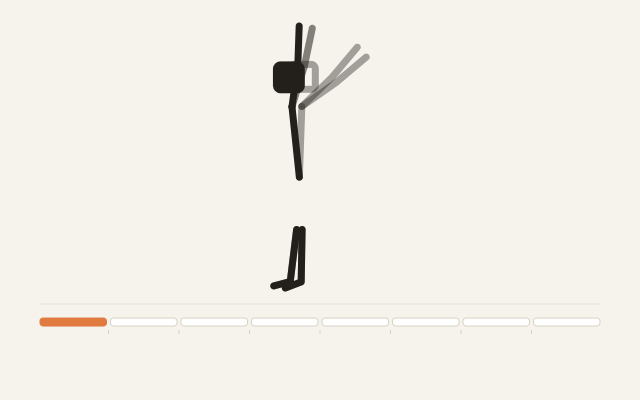
Stand up and reach overhead, then let the arms come down slowly. Two or three times, each one taller than the last.
8 steps · 10 min

Before you start
General movement information, not medical advice. If a step produces pain that outlasts the step itself, skip it and have the area looked at before continuing.
Step table
StepHoldSideWhat you should feel
1. Standing reach up70s + 5sboth sidesStand up and reach overhead, then let the arms come down slowly. Two or three times, each one taller than the last.
2. Standing side reach65s + 10sboth sidesOne arm overhead, lean away from it and hold for four breaths, then change sides. Keep both feet planted and the hips level.
3. Standing forward fold70s + 5sboth sidesSoft knees, hands toward the floor or the chair seat, head hanging. Let the neck go completely — it has been holding your head up all day.
4. Chair twist with reach65s + 10sright sideSitting, turn to the right and take the left hand to the outside of the right knee. Turn from the ribs, not by pushing with the arm.
5. Standing hip circle70s + 5sleft sideHand on the desk, weight on the right leg, draw eight slow circles with the left knee. Then eight the other way.
6. Standing lunge at the desk65s + 10sleft sideLeft foot forward, back heel lifted, sink straight down with the hands on the desk. Tuck the tailbone or the movement lands in the lower back.
7. Wall calf and ankle70s + 5sboth sidesHands on the wall, one leg back with the heel down, then bend the back knee for the lower calf. Both sides.
8. Standing breath with hands on ribs60s + 15sboth sidesHands on the lower ribs, six slow breaths, feeling the ribs widen rather than the shoulders lift. Then sit back down and notice what changed.

How to run this sequence

Stillness is the problem, not sitting

The research on desk work keeps pointing at the same thing: the issue is not the posture, it is how long it is held without change. A twenty-minute break every two hours does less for you than standing up for ninety seconds every thirty minutes. This sequence is designed to work either way — run it whole as a ten-minute reset, or run steps three, four and seven as a ninety-second version four times a day.

The order runs head to feet and back

Spine first because everything below it organises around it; hips second because they take the longest to feel anything; legs third; shoulders last because they are the part that a desk worker can actually feel already, and starting there would mean spending the whole ten minutes on the symptom:

  • Steps one to three: standing reach, side reach, and a slow standing fold to take the spine through both directions.
  • Steps four and five: a chair twist and a standing hip circle, which is the only rotation the hips get all day.
  • Steps six and seven: a lunge for the front of the hip and a calf and ankle step for the back of the leg.
  • Step eight: shoulders and breath, done standing, as the finish.

Make it hard to skip

The reason desk sequences fail is friction: if the mat is in another room, it does not happen. Everything here can be done in the clothes you are already wearing, in the space beside your desk, without taking anything off or putting anything down. If you have to change clothes to do it, the routine is designed wrong.

Questions about this sequence

Is ten minutes enough to matter?

For interrupting stiffness, yes — most of the benefit comes from the first two or three minutes of movement after a long static period. For changing range of motion, ten minutes once a day is not much. That is why the same steps appear in longer sequences elsewhere in the library.

Should I do it at the same time every day?

Anchoring it to something you already do — the end of a meeting, the point where you refill your water — works far better than a time on the clock. The clock version gets skipped the first busy day and never comes back.

My office has no wall space. What then?

Only step six needs the wall, and a desk edge or a closed door works identically. Everything else needs a chair and about a square metre of floor. If you have neither, the four-step sitting version at your desk is still worth doing.

Other sequences that pair well

Ten Minute Standing Hip Circles — Preview rail

Ten Minute Standing Hip Circles

10 min8 stepsGentleHips

This is the sequence for the day you cannot lie down. Every step happens on your feet, which means the hip has to move while also holding you up — a different job from the same movement on a mat, and the one your hips actually do all day. The first half circles the joint through its full available range, the second half loads it at the end of that range.

Ten Minute Morning Mid-Back Open — Preview rail

Ten Minute Morning Mid-Back Open

10 min8 stepsGentleThoracic spine

The mid-back is the part of the spine that stiffens overnight and then spends the day being asked to rotate. This sequence spends its first half on the floor, moving the twelve vertebrae behind the ribs through flexion, extension and rotation, and its second half on your front and side, where the same joints get opened against gravity. Nothing is loaded and nothing is forced; the holds are long enough that the tissue has time to change.