Skip to the player
Unkink
timed stretching, cued by the second

Ten Minute Morning Mid-Back Open

10 min8 stepsGentleThoracic spinePublished 20 Aug 2026

The mid-back is the part of the spine that stiffens overnight and then spends the day being asked to rotate. This sequence spends its first half on the floor, moving the twelve vertebrae behind the ribs through flexion, extension and rotation, and its second half on your front and side, where the same joints get opened against gravity. Nothing is loaded and nothing is forced; the holds are long enough that the tissue has time to change.

Cat and cow
Cat and cow
Holding · both sides
10:00
1 / 8
Five slow rounds. Push the floor away at the top of the arch and let the shoulder blades separate on the rounding.
8 steps · 10 min

Before you start
General movement information, not medical advice. Do not use this sequence to work around a known disc, rib or shoulder problem; get those assessed before you put load or rotation through them.
Step table
StepHoldSideWhat you should feel
1. Cat and cow70s + 5sboth sidesFive slow rounds. Push the floor away at the top of the arch and let the shoulder blades separate on the rounding.
2. Cat and cow, ribs only65s + 10sboth sidesSecond round, keep the pelvis still and move only the ribcage. Small, slow, and the movement should feel like it lives between the shoulder blades.
3. Thread the needle70s + 5sleft sideLeft arm passes under the right, left shoulder and temple resting down. A wide pull across the left shoulder blade — the hips stay level, square to the floor.
4. Thread the needle65s + 10sright sideRight arm under the left. Breathe into the back of the right ribs; if the neck is taking the stretch, put something under the head.
5. Child's pose with reach70s + 5sboth sidesSit back toward the heels and walk both hands forward. The long line runs from the fingertips to the sit bones, and the lower back should feel wide, not compressed.
6. Sphinx70s + 5sboth sidesForearms down, elbows under the shoulders, front ribs drawing back. Extension should arrive between the ribs, not in the lower back.
7. Prone swan65s + 10sboth sidesPress the hands down and lift the chest a hand's width higher than sphinx. Legs heavy, head in line with the spine, no craning.
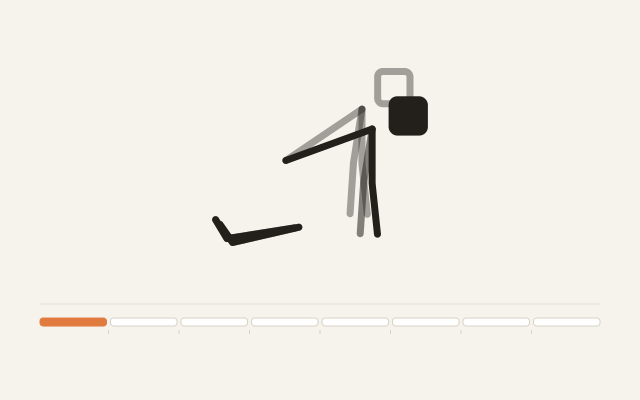
8. Seated thoracic rotation65s + 10sright sideSit tall, hands crossed on the chest, and turn from the ribs while the hips face forward. The finish should feel like a spiral, not a wrench.

How to run this sequence

Floor first, then the harder angles

Cat and cow wakes up the whole segmental chain in flexion and extension while your body weight is shared with the floor. Thread the needle adds rotation, which is the movement the mid-back is built for and has usually lost. Only after that does the sequence ask for extension against gravity (sphinx, then swan), because extension is the direction that feels worst first thing in the morning and should arrive on tissue that has already been moved.

Where the movement should come from

If the stretch is landing in the lower back instead of between the shoulder blades, the ribs are not moving. Two corrections fix most of it:

  • In cat and cow, think of pushing the sternum away from the pelvis rather than dropping the belly.
  • In thread the needle, rest the shoulder and temple on the floor and let the top hand reach — do not twist the hips to chase depth.
  • In sphinx and swan, keep the legs heavy and the front ribs drawing back toward the spine so the extension comes from between the ribs.

The morning caveat

The first hour after waking is when the discs hold the most fluid and the spine is at its least tolerant of end-range bending, which is why this sequence never asks for a full forward fold or a big twist. If any step produces a sharp pain rather than a stretch, stop the sequence and start your day — this is a maintenance routine, not a treatment for something that is already inflamed.

Questions about this sequence

Do I need to warm up before this?

No — the first two steps are the warm-up. If you have been awake for less than ten minutes, spend the first step moving a bit smaller and slower than feels necessary. If you are already warm from a shower or a walk, you can start at normal range.

Why is there nothing for the lower back in a mid-back sequence?

Because the lower back is not usually the joint that is short — it is the one that compensates when the mid-back stops moving. Opening the thoracic spine is what takes the load off the lumbar spine. If your lower back is the thing that hurts, this sequence is a reasonable first step but it is not a diagnosis.

Can I run it in the evening instead?

Yes, and many people prefer it there. The trade-off is that the morning benefit — arriving at your desk with a mid-back that can still rotate — is lost. If you only have one slot, morning is the better investment; evening is better than nothing.

Other sequences that pair well

Fifteen Minute Bedtime Spine and Hip Release — Preview rail

Fifteen Minute Bedtime Spine and Hip Release

15 min10 stepsGentleThoracic spineHips

Nothing here is meant to change your range. This sequence is about the thing that actually decides how you sleep: whether the body is still holding the day in its back and hips when you lie down. Every step is slow, every step ends lying or sitting, and the last one is chosen so that getting into bed afterwards is a two-second movement rather than a project.

Ten Minute Desk Break, Whole Body — Preview rail

Ten Minute Desk Break, Whole Body

10 min8 stepsGentleFull body

This is the sequence to run when you have been still for too long and nothing in particular hurts. It touches every area in the order the body asks for them — spine, hips, legs, shoulders — and it uses only a chair and a wall, so there is no reason for it not to happen. It is deliberately gentle: the goal is to interrupt stillness, not to train.

Ten Minute Standing Hip Circles — Preview rail

Ten Minute Standing Hip Circles

10 min8 stepsGentleHips

This is the sequence for the day you cannot lie down. Every step happens on your feet, which means the hip has to move while also holding you up — a different job from the same movement on a mat, and the one your hips actually do all day. The first half circles the joint through its full available range, the second half loads it at the end of that range.