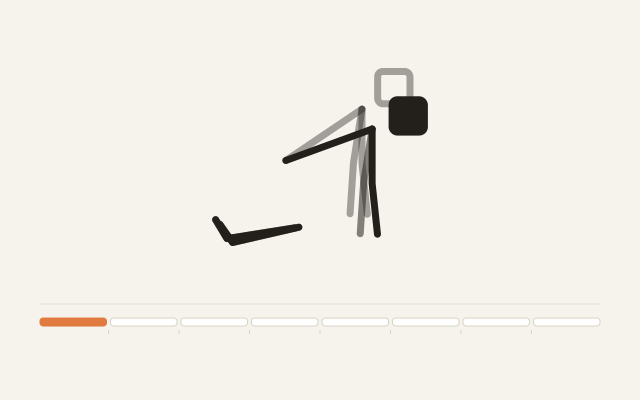
Sitting does not shorten the hip flexors so much as teach them to stay switched on. This sequence alternates the two things that actually change that: a long, supported lengthening of the front of the hip (the lunges), and an active squeeze of the opposite glute, which is what tells the hip to let go in the first place. The last two steps are rotations, because a hip that can lengthen but not turn is still a hip that will complain.
Cat and cow
Holding · both sides
10:00
1 / 8
Four rounds to move the pelvis before you ask the hip to do anything. Stop where the movement is still easy.
8 steps · 10 min
Before you start General movement information, not medical advice. Hips with a labral tear, a recent replacement or a history of pinching at end range should be cleared by a clinician before long holds.
Step table
Step
Hold
Side
What you should feel
1. Cat and cow
70s + 5s
both sides
Four rounds to move the pelvis before you ask the hip to do anything. Stop where the movement is still easy.
2. Low lunge
65s + 10s
left side
Right knee down, left foot forward. Tuck the tailbone, squeeze the right glute at 30%, and let the stretch spread across the front of the right hip.
3. Low lunge, other side
70s + 5s
right side
Left knee down now. Hands can come to the brick; the lower back stays long rather than arching to find depth.
4. 90/90 hip switch
65s + 10s
both sides
Both knees bent at right angles, sitting tall. Lean over the front shin — the stretch is in the back hip, and the front knee should feel nothing at all.
5. Pigeon
70s + 5s
left side
Left shin across, right leg back, hips square. A deep, dull ache in the left glute is the target; a sharp pull at the front of the left knee means the shin is too horizontal.
6. Pigeon
65s + 10s
right side
Right shin across. Fold forward only as far as the breath stays easy — a folded pigeon is not better than an upright one, it is just deeper.
7. Supine knee hug
70s + 5s
both sides
Both knees in, tailbone heavy. This is the counter-pose: the lower back flattens and the hip joint is unloaded after the lunges.
8. Supine twist
65s + 10s
right side
Knees fall to the right, left shoulder stays on the floor. Ask for rotation at the hip, not a twist through the lower back.
How to run this sequence
The glute is the other half of the stretch
A hip flexor will happily keep pulling while you lean into it, which is why passive lunging alone plateaus quickly. Contracting the glute on the same side gives the brain a reason to release the front: one muscle switches off so the other can work. In every lunge step here, squeeze the back-side glute at about 30% effort and keep squeezing through the hold, then let go a few seconds before the bell.
Setup details that decide whether it works
Two minutes of setup saves you the whole ten minutes of guessing:
Back knee directly under the hip, or slightly behind it. If the knee is in front, you are stretching the knee, not the hip.
Tuck the tailbone under before you lift the chest. Without the tuck, the lower back provides the movement and the hip gets none of it.
A brick under the hand of the lunging side turns a wobbly hold into a ten-minute-long one you can actually breathe in.
If it pinches at the front of the hip
A pinch (rather than a stretch) at the front of the hip usually means the joint is being jammed at the end of its range while the tissue is not ready. Come out of the depth by half, tuck the tailbone more, and take the back knee slightly further behind you. If the pinch is still there after those three changes, skip the deep lunges in this sequence and keep the 90/90 and supine steps.
Questions about this sequence
How long before I notice a difference?
Standing up after the first session feels different for most people, and that feeling lasts an hour or two. A change you can still detect the next morning usually takes two to three weeks of four or five sessions a week. Sense of relief and lasting change are not the same thing.
Do I need the brick?
No. A stack of books, a cushion or a rolled mat works. The brick is there to let you stop holding yourself up, which is what makes a long hold possible at all.
Is it normal for the front of the thigh to go numb?
Not normal, and not something to sit through. Numbness or tingling in the front of the thigh can come from pressure on a nerve under the hip crease. Come out, shake the leg out and shorten the hold. If it repeats, have it looked at before continuing with long holds.
This is the longest and deepest sequence in the library and it is built for people who already move regularly. Five positions are held for around ninety seconds each, twice, with a supported counter-pose between them. Nothing here is forced, but the holds are long enough that the nervous system has to make an actual decision to let go — which is the difference between this and a ten-minute routine you can do while thinking about something else.
Nothing here is meant to change your range. This sequence is about the thing that actually decides how you sleep: whether the body is still holding the day in its back and hips when you lie down. Every step is slow, every step ends lying or sitting, and the last one is chosen so that getting into bed afterwards is a two-second movement rather than a project.
This is the sequence for the day you cannot lie down. Every step happens on your feet, which means the hip has to move while also holding you up — a different job from the same movement on a mat, and the one your hips actually do all day. The first half circles the joint through its full available range, the second half loads it at the end of that range.