Two muscles run down the back of the lower leg and they need different angles: the gastrocnemius crosses the knee, so it only lengthens with a straight leg; the soleus sits below the knee, so it only lets go when the knee is bent. This ladder does both, in that order, on both sides, and finishes by reminding the ankle that it can move in more than one direction.
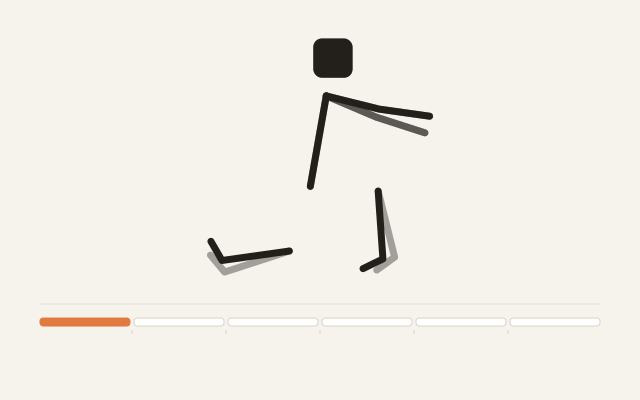
Knee to wall
Holding · left side
5:00
1 / 6
Heel down, toes straight ahead, and travel the left knee toward the wall. Note how far it gets — that distance is your ankle range, not your calf length.
6 steps · 5 min
Before you start General movement information, not medical advice. Sharp pain, swelling, heat or bruising in the calf or achilles needs assessment, not stretching.
Step table
Step
Hold
Side
What you should feel
1. Knee to wall
45s + 5s
left side
Heel down, toes straight ahead, and travel the left knee toward the wall. Note how far it gets — that distance is your ankle range, not your calf length.
2. Knee to wall
40s + 10s
right side
Same on the right. If one side stops a hand's width short of the other, that ankle is the one driving the tightness on that leg.
3. Wall calf stretch
45s + 5s
left side
Left leg back, knee straight, heel pressing down. The line should run from the back of the knee to the heel — if it stops at mid-calf, you are leaning too far in.
4. Bent-knee wall calf
40s + 10s
right side
Right leg back with the knee softly bent and the heel still down. This is the one that reaches the soleus — expect it lower, closer to the achilles.
5. Stair drop
45s + 5s
both sides
Balls of the feet on the edge of a step, heels dropping below the level of the step. Two feet only — no single-leg version until the achilles is quiet.
6. Standing calf raise stretch
35s + 15s
both sides
Rise slowly onto the toes, hold the top for two seconds, then lower the heels further than they started. The slow lowering is the part that matters.
How to run this sequence
Straight leg first, bent knee second
Every calf sequence that only straightens the leg misses the soleus, which is the one that gets thick and tight from standing and walking. Do the straight-leg version first (wall calf and knee-to-wall), then the bent-knee version, so the deeper muscle is not being blocked by the surface one. If you are short on time, the bent-knee version is the one to keep.
Three details people get wrong
The calf is a small joint with a long lever, which means small setup errors hide the whole stretch:
Back heel must stay on the floor with the toes pointing straight ahead, not turned out. Turning the foot out is the standard way to cheat this stretch.
The back knee stays straight in the straight-leg version — a slight bend puts the stretch back into the joint rather than the muscle.
Push the wall away slowly rather than leaning in fast; the feeling should build over about five seconds, not arrive all at once.
Why the ankle is in a calf sequence
The calf and the ankle are one system. A stiff ankle joint makes the calf work harder with every step, which is why a calf that is stretched but still attached to an immobile ankle keeps tightening back up. The knee-to-wall step measures that directly: if the knee cannot travel toward the wall while the heel stays down, the limitation is at the joint, not the muscle, and no amount of stretching the calf will change it.
Questions about this sequence
Should I stretch before or after running?
Long holds before running are the wrong tool — they quiet the reflex that protects the ankle while you land on it. Use this sequence after running, or on its own in the evening. If you want something before a run, do two or three slow repetitions through the range instead of holding.
My achilles has been sore — can I still do this?
Skip the straight-leg holds and the stair drop and keep only the gentle bent-knee version with a small range. A sore achilles that gets worse during the holds is the signal to stop and have it looked at. Tendons that are already irritated do not usually respond to more stretching.
Does a foam roller do the same thing?
No. Rolling is a short, intense pressure that feels good for a few minutes and changes the tissue very little. What changes a calf is time at a length. The two work together — roll for a minute, then run this ladder — but the ladder is the part that holds.
The shoulder blade is a bone that floats on the back of the ribcage and is supposed to slide upward, downward and around it. A day of typing holds it in one place for hours, and the muscles that normally move it stop being asked. This sequence spends five minutes asking, in a small range, with almost no load — which is exactly what a shoulder that has been still all day can accept.
The two muscles on the back of the leg are continuous in how they behave: a calf that tightens pulls on the hamstring through the pelvis, and a hamstring that will not lengthen makes the calf work harder on every stride. This sequence is built for after a run, when the tissue is warm and the sequence can afford to be specific. It starts at the ankle, moves up to the back of the knee, and finishes with the long line from the sit bone to the heel.
A wall gives you something a floor cannot: instant feedback. If your mid-back does not move, the wall will not let you pretend otherwise, because your lower back has to lift off it. This sequence uses that feedback to open the front of the chest and the front of the shoulders — the two places that a day of typing pulls forward and holds there.