Skip to the player
Unkink
timed stretching, cued by the second

Fifteen Minute Post-Run Calf and Hamstring

15 min10 stepsStandardCalves & anklesHamstringsPublished 8 Sep 2026

The two muscles on the back of the leg are continuous in how they behave: a calf that tightens pulls on the hamstring through the pelvis, and a hamstring that will not lengthen makes the calf work harder on every stride. This sequence is built for after a run, when the tissue is warm and the sequence can afford to be specific. It starts at the ankle, moves up to the back of the knee, and finishes with the long line from the sit bone to the heel.

Knee to wall
Knee to wall
Holding · left side
15:00
1 / 10
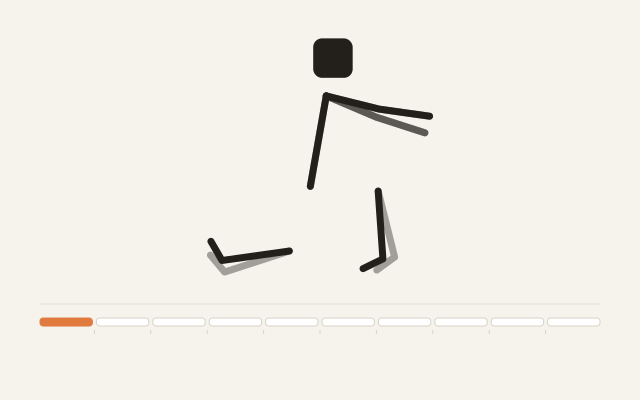
Left heel down, knee toward the wall. After a run this often feels tighter than usual, so measure the distance and do not chase it.
10 steps · 15 min

Before you start
General movement information, not medical advice. Calf pain that comes on suddenly during a run, or a calf that is swollen, hot and painful to touch, needs assessment rather than stretching.
Step table
StepHoldSideWhat you should feel
1. Knee to wall85s + 5sleft sideLeft heel down, knee toward the wall. After a run this often feels tighter than usual, so measure the distance and do not chase it.
2. Knee to wall80s + 10sright sideRight side. If the difference between the two sides has grown since your last easy day, the tighter side is the one absorbing more of the load.
3. Wall calf, straight leg75s + 15sboth sidesBack leg straight, heel down, toes forward. Lean in slowly over five seconds and then hold — the tissue is warm, so the range will keep creeping.
4. Wall calf, bent knee80s + 10sboth sidesSame position with the back knee bent. This goes below the knee to the soleus, which is the one that cramps at kilometre eight.
5. Stair drop, both feet85s + 5sboth sidesBalls of the feet on a step edge, heels slowly below the step. Skip this step entirely if the achilles is tender today.
6. Downward dog80s + 10sboth sidesThis is the bridge between the calf and the hamstring — both are under tension at once. Bend the knees as much as you like and pedal the heels.
7. Half split75s + 15sleft sideLeft leg forward and straight, hips high above the back knee. Hinge at the hip and keep the left foot flexed — a pointed foot moves the stretch to the calf.
8. Half split80s + 10sright sideRight leg forward. If the back knee complains, put a folded towel under it — the front leg is the one being worked.
9. Supine hamstring with belt75s + 15sleft sideBelt over the left arch, right leg flat and heavy. Straighten the knee only as far as the sit bone stays on the floor.
10. Supine hamstring with belt80s + 10sright sideRight leg up. Hold, breathe out slowly, and let the leg drop a centimetre on each exhale rather than pulling it in.

How to run this sequence

Warm tissue, specific work

Stretching after a run is not about undoing the run — it is about using a window that closes within about an hour. Warm tissue tolerates a longer hold with less guarding, which is why this sequence uses eighty-second holds where the five-minute calf routine uses forty. If more than two hours have passed since the run, run anyway, but expect to spend the first two steps just finding the range.

Do not stretch a tired calf hard

The reflex that protects the ankle and calf is a fatigue-sensitive one, and it is at its most trigger-happy right after a hard session. Two rules keep this safe:

  • If the run was a race or a hard interval session, cut every hold to about half and skip the stair drop entirely for the first 24 hours.
  • Never bounce or pulse at the end of the range here. Slow, steady pressure is what the tissue responds to when it is already tired.
  • If the calf is sore to touch rather than tight under stretch, stop — that is a different signal and stretching is the wrong response.

The hamstring part is not an afterthought

Runners tend to know their calves and neglect the hamstring, which is the muscle that actually limits stride length. The supine belt steps at the end are the ones that matter most: lying down takes the lower back out of the stretch, which means you can finally tell the difference between a short hamstring and a tired one. If the leg feels heavy and weak rather than tight, stop and eat something instead.

Questions about this sequence

Is it better to do this before bed instead?

You get a longer, more tolerant stretch before bed, but you lose the warm-tissue window. If you finished running in the evening, both line up. If you ran in the morning, do a shortened version straight after and the full sequence in the evening.

Should the hamstring stretch feel different after a run?

It usually feels easier for the first thirty minutes because the tissue is warm and the nervous system is already tolerant. If it feels sharper than on a rest day, the hamstring is likely guarding, not short — halve the range and keep the knee more bent.

How soon can I run again?

Nothing here affects that. Range work does not impair recovery, and it does not create the tissue damage that a hard session does. If you are following a training plan, this sequence fits into an easy day without any adjustment.

Other sequences that pair well

Fifteen Minute Hamstring Ladder — Preview rail

Fifteen Minute Hamstring Ladder

15 min10 stepsStandardHamstrings

Four positions, ten steps, one direction of movement. The ladder starts standing, goes to the floor, then lies you down where the hamstring can finally be reached without the lower back helping. Ten holds of eighty seconds, spread over fifteen minutes, is enough time for the tissue to actually change rather than just feel pulled — which is why this one is a fifteen and not a five.

Five Minute Calf and Ankle Ladder — Preview rail

Five Minute Calf and Ankle Ladder

5 min6 stepsGentleCalves & ankles

Two muscles run down the back of the lower leg and they need different angles: the gastrocnemius crosses the knee, so it only lengthens with a straight leg; the soleus sits below the knee, so it only lets go when the knee is bent. This ladder does both, in that order, on both sides, and finishes by reminding the ankle that it can move in more than one direction.