Skip to the player
Unkink
timed stretching, cued by the second

Fifteen Minute Hamstring Ladder

15 min10 stepsStandardHamstringsPublished 27 Aug 2026

Four positions, ten steps, one direction of movement. The ladder starts standing, goes to the floor, then lies you down where the hamstring can finally be reached without the lower back helping. Ten holds of eighty seconds, spread over fifteen minutes, is enough time for the tissue to actually change rather than just feel pulled — which is why this one is a fifteen and not a five.

Cat and cow
Cat and cow
Holding · both sides
15:00
1 / 10
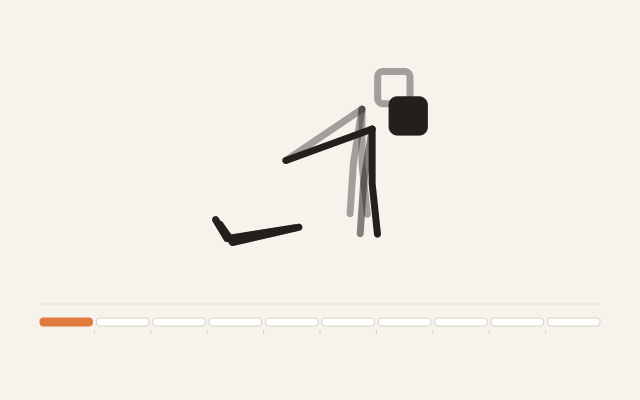
Four rounds. Do not skip this — a folded position with a stiff spine puts the whole stretch into the lower back.
10 steps · 15 min

Before you start
General movement information, not medical advice. A hamstring that tingles, burns or feels weak rather than tight should be assessed before you stretch it further.
Step table
StepHoldSideWhat you should feel
1. Cat and cow85s + 5sboth sidesFour rounds. Do not skip this — a folded position with a stiff spine puts the whole stretch into the lower back.
2. Downward dog80s + 10sboth sidesHeels reaching down, knees as bent as they need to be. Pedal the feet slowly — the hamstring starts long before the heel touches the floor.
3. Standing forward fold75s + 15sboth sidesSoft knees, head heavy, hands on the floor or on a brick. The stretch should sit at the top of the thigh, not as a pull at the back of the knee.
4. Half split80s + 10sleft sideLeft leg forward and straight, hips high, hinge from the hip rather than rounding. A long line from the left sit bone toward the heel.
5. Half split85s + 5sright sideSame on the right. Keep the pelvis square — turning the hip out is how the stretch quietly moves to the inner thigh.
6. Seated forward fold75s + 15sboth sidesSit on a folded mat if the pelvis rolls back. Fold from the hips: the belly comes down first, then the chest, and the head never leads.
7. Seated belt hamstring80s + 10sleft sideBelt around the left arch, leg straight, both ends in the left hand. Sit tall and let the leg travel toward the chest only as far as the spine stays long.
8. Seated belt hamstring75s + 15sright sideRight side now. To make it gentler, bend the knee and slide the heel along the floor instead of lifting the whole leg at once.
9. Supine hamstring with belt85s + 5sleft sideFace up, belt over the left arch, left leg rising with the knee softly bent. The free right leg stays flat and heavy — that is what tells the pelvis to stay neutral.
10. Supine hamstring with belt80s + 10sright sideRight leg up, left leg heavy. Straighten the knee only as far as it can go without the sit bone lifting off the floor.

How to run this sequence

Why so many steps for one muscle

The hamstring crosses two joints, the hip and the knee, and its length changes depending on what the pelvis is doing. Standing folds load it with your body weight and no support; seated folds change the pelvis angle; the supine belt positions take the lower back out of the equation entirely and let you control the tension with your arms. Four angles reach four different parts of the same muscle group, and the last step is the one most people discover something in.

The belt is not a shortcut, it is a brake

Using a belt around the foot is not cheating — it lets you stop pulling with your hands and start relaxing the leg. Setup:

  • Loop the belt over the arch, not the toes. Over the toes, the ankle has to work and the hamstring gets less.
  • Hold both ends in one hand and let the arm be straight; the tension comes from the leg dropping, never from hauling the leg toward you.
  • Keep the other leg heavy and flat. If the free knee pops up, you have gone past the range you actually own.

When a hamstring is guarding, not short

If the stretch feels sharp, near the sit bone, or produces a tingling line down the back of the leg, the muscle may be protecting a nerve rather than lacking length. The test: the same position with the knee slightly bent and the foot relaxed should feel completely different. If bending the knee drops the sensation to zero, the limit is neural, and pushing into it is the one thing that makes it worse. Slow down, back the range off by a third, and use the steps where the knee is bent.

Questions about this sequence

How long until the range actually changes?

Range measured immediately after a session typically improves by a few centimetres, and most of that is nervous-system tolerance rather than tissue. Measured on a cold morning two weeks later, changes of two to four centimetres are realistic with five sessions a week.

Should I feel this behind the knee?

You can feel a soft stretch there, but not a sharp catch or a pulling sensation inside the joint. Sharpness behind the knee usually means the calf is taking the load because the hamstring stopped moving — bend the knee slightly and try again.

Is it bad to be able to fold all the way forward?

Not by itself, but a very deep forward fold in someone with a stiff mid-back means the movement is coming entirely from the hamstrings and the lower back. In that case, work on the mid-back as well — the two sequences are designed to be run in the same week.

Other sequences that pair well

Fifteen Minute Post-Run Calf and Hamstring — Preview rail

Fifteen Minute Post-Run Calf and Hamstring

15 min10 stepsStandardCalves & anklesHamstrings

The two muscles on the back of the leg are continuous in how they behave: a calf that tightens pulls on the hamstring through the pelvis, and a hamstring that will not lengthen makes the calf work harder on every stride. This sequence is built for after a run, when the tissue is warm and the sequence can afford to be specific. It starts at the ankle, moves up to the back of the knee, and finishes with the long line from the sit bone to the heel.