Skip to the player
Unkink
timed stretching, cued by the second

Five Minute Rib and Breathing Reset

5 min6 stepsGentleThoracic spinePublished 27 Oct 2026

This is the sequence that is not really about stretching. It moves the ribs and the mid-back in the positions where the breath can reach them, and the point is to restore the sideways and backward expansion that a day of shallow upper-chest breathing takes away. Five minutes, no strong sensation, and it is the one sequence in the library that is equally useful on a day when nothing hurts.

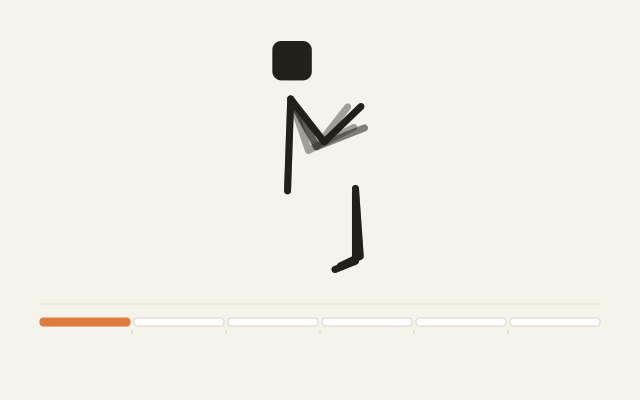
Hands on ribs, seated
Holding · both sides
5:00
1 / 6
Sit tall, hands wrapped around the lower ribs, six slow breaths. Feel where the movement goes without trying to send it anywhere yet.
6 steps · 5 min

Before you start
General movement information, not medical advice. Breathlessness at rest, chest pain, or a persistent cough needs medical assessment rather than breathing exercises.
Step table
StepHoldSideWhat you should feel
1. Hands on ribs, seated45s + 5sboth sidesSit tall, hands wrapped around the lower ribs, six slow breaths. Feel where the movement goes without trying to send it anywhere yet.
2. Cat and cow with breath40s + 10sboth sidesRound on the exhale and arch on the inhale, five rounds. Slower than usual — this is the ribs moving, not an exercise.
3. Child's pose with breath45s + 5sboth sidesSit back to the heels, arms forward, and breathe into the back of the ribs. Put the hands on the back of the ribcage and feel it widen.
4. Side bend with breath40s + 10sleft sideLean left with the right hand on the right ribs. Breathe into the right side specifically — four breaths, one direction, then swap.
5. Sphinx with breath45s + 5sboth sidesForearms down, front ribs drawing back, and breathe into the front of the ribcage without letting the lower back arch.
6. Supine knee hug with breath35s + 15sboth sidesBoth knees in, tailbone heavy, six slow breaths with a long exhale. Finish lying down, then get up slowly and notice the first breath you take sitting.

How to run this sequence

Where the breath goes when you are concentrating

Under load, breathing moves up into the upper chest and neck and stops travelling sideways into the lower ribs. Do that for eight hours and the lower ribs stop moving altogether, which is one of the reasons the mid-back stiffens even when you have not been sitting badly. Putting a hand on each side of the lower ribs and breathing into them is the fastest way to find out how much of that has happened.

The steps that matter most

All six are useful; two of them carry most of the change:

  • The hands-on-ribs breath, done in a few different positions, is the whole point of the sequence. Three minutes of it in three positions beats any amount of stretching.
  • The child pose and the side bend put the ribs into a shape where one side has to expand more than the other, which is the direction a desk day never asks for.
  • The sphinx step at the end adds a small extension, which is what the front of the ribcage needs after a day of being folded forward.

How to tell it is working

The marker is not flexibility, it is where the breath arrives without you directing it. After a few sessions, the first breath after sitting down will start to travel into the lower ribs on its own. That is the change worth looking for — not a deeper fold, and not a bigger twist. If the sequence instead produces light-headedness, you are breathing too hard or too fast; slow it down and breathe out longer than you breathe in.

Questions about this sequence

Should I breathe through the nose or the mouth?

Nose, if it is available. Nasal breathing keeps the volume lower and the pace slower, which is what makes the ribs move rather than the shoulders. If your nose is blocked, breathe through the mouth but keep the same slow pace.

How long should the exhale be?

Roughly twice the inhale. Four seconds in and eight out is a good starting ratio, and it is more useful than any amount of forceful inhaling — the exhale is what lets the ribs settle.

Can I do this lying down in bed?

The breath steps work perfectly lying down and the child pose works on a firm bed. The side bend and the sphinx step need a floor. If you only do the breath steps, you have still done the part of this sequence that changes the most.

Other sequences that pair well

Five Minute Desk Neck and Shoulder Sprint — Preview rail

Five Minute Desk Neck and Shoulder Sprint

5 min6 stepsGentleNeck & shoulders

No mat, no floor, no standing up. This is the fastest sequence in the library and it is designed to be done with one hand on the chair and the other still holding a pen. It works the neck in the four directions it actually moves, anchors the shoulder for each of them, and finishes with the two minutes of shoulder movement that make the neck part hold.

Ten Minute Brick Roll for the Mid Back — Preview rail

Ten Minute Brick Roll for the Mid Back

10 min8 stepsStandardThoracic spine

Instead of holding one position, this sequence moves the support down the mid-back one segment at a time and works each one briefly. That is a different stimulus from a single long extension: it reaches segments that a single brick position never touches, and it teaches the mid-back to move through extension rather than simply to arrive in it and stay.

Ten Minute Brick Thoracic Extension — Preview rail

Ten Minute Brick Thoracic Extension

10 min8 stepsStandardThoracic spine

A brick under the mid-back turns extension from something you do with your lower back into something you can direct at one segment at a time. This sequence uses it in two ways — as a support to drape over while breathing, and as a fulcrum to move over — and pairs both with rotation, because a mid-back that can extend but not turn is still going to send the load somewhere else.