Skip to the player
Unkink
timed stretching, cued by the second

Ten Minute Brick Thoracic Extension

10 min8 stepsStandardThoracic spinePublished 4 Oct 2026

A brick under the mid-back turns extension from something you do with your lower back into something you can direct at one segment at a time. This sequence uses it in two ways — as a support to drape over while breathing, and as a fulcrum to move over — and pairs both with rotation, because a mid-back that can extend but not turn is still going to send the load somewhere else.

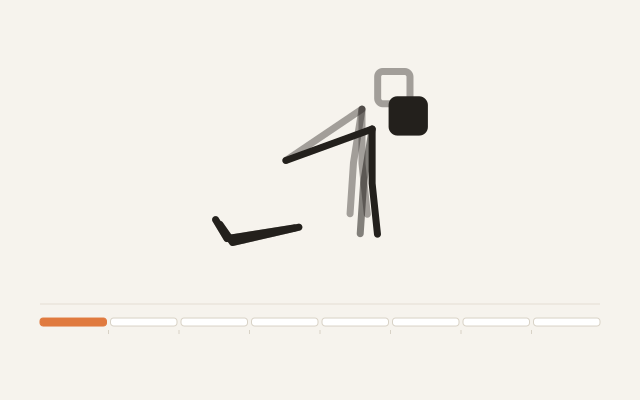
Cat and cow
Cat and cow
Holding · both sides
10:00
1 / 8
Six rounds to move the segments before you load them. Note which part of the back moves least — that is where the brick goes.
8 steps · 10 min

Before you start
General movement information, not medical advice. Osteoporosis, a known compression fracture, or mid-back pain that is worse at night, makes loaded extension inappropriate without medical clearance.
Step table
StepHoldSideWhat you should feel
1. Cat and cow70s + 5sboth sidesSix rounds to move the segments before you load them. Note which part of the back moves least — that is where the brick goes.
2. Brick extension, low65s + 10sboth sidesBrick under the mid-back, hands supporting the head, elbows up. Start with the brick lengthways for a gentler angle, and breathe into the ribs for the whole hold.
3. Brick extension, crossways70s + 5sboth sidesBrick crossways under the same segment for a stronger angle. Stop at the point where the lower back still feels flat on the floor.
4. Sphinx65s + 10sboth sidesForearms down, elbows under the shoulders, front ribs drawing back. This is the same extension without the prop — the contrast tells you how much of it you can now hold yourself.
5. Prone swan70s + 5sboth sidesHands pressing down, chest lifted a hand higher than sphinx. Legs heavy, glutes soft, and no lifting of the chin.
6. Thread the needle65s + 10sleft sideLeft arm under, shoulder and temple down. Rotation right after extension — this is where you find out whether the new range can actually be used.
7. Seated rotation70s + 5sboth sidesSit tall on the brick, hands crossed on the chest, turn each way four times. Compare the two directions to how they felt at the start of the session.
8. Child's pose with reach65s + 10sboth sidesSit back to the heels, arms forward, and let the back round completely. After ten minutes of extension, the flexion is what makes the change stick.

How to run this sequence

Put the brick where the stiffness is

The brick is only useful if it is under the segment that is not moving. Roll it up or down the mid-back one vertebra at a time and find the spot where, when you drape over it, the movement happens at the brick rather than at the neck or the lower back. That is the segment to work. Most people find it between the shoulder blades, at the level of the bottom of the shoulder blade tips.

Three rules for extending over a brick

Loaded extension is the direction most likely to hurt if it is done carelessly:

  • Never put the brick under the lower back. The lumbar spine does not need help extending and it is the one place where this can genuinely cause harm.
  • Support the head with both hands so the neck is not hanging. A supported head lets you relax into the position for a full minute.
  • Come out slowly, rolling onto one side rather than sitting straight up. The straight-up version puts the whole extension range back through the spine in a second.

And the rotation steps afterwards

Extension and rotation are the pair that a stiff mid-back loses together. Once you have the extension, the sequence uses it in a rotation — the thread the needle and the seated rotation are there so the new range is available in a movement you actually make. Doing the extension and stopping is the most common way this sequence gets run and the least useful version of it.

Questions about this sequence

My mid-back cracks over the brick — is that bad?

A painless crack as the segments open is common and is usually gas releasing from the joint. It is not the goal, and chasing it by dropping harder onto the brick is how people end up sore. If the crack comes with pain, stop and reduce the height of the support.

What if a brick is too high?

A rolled towel or a thin cushion is a better starting point for most people. The brick is roughly nine centimetres, which is a lot for a stiff mid-back. Use whatever height lets you breathe slowly in the position; the height is not the achievement.

How often can I do this?

Daily is fine at low height. If you are working at brick height and it produces a satisfying but strong sensation, four or five times a week is plenty — the tissue needs a day off between strong extension sessions.

Other sequences that pair well

Ten Minute Deep Glute Release — Preview rail

Ten Minute Deep Glute Release

10 min8 stepsStandardHips

The deep glute muscles sit under the big one and rotate the hip. They are also the muscles that most often get blamed for a pain that is actually coming from somewhere else — which is why this sequence spends its first steps on the positions that reliably change how the back of the hip feels, and its last steps on the movement that tells you whether it worked.

Ten Minute Seated Thoracic Rotation — Preview rail

Ten Minute Seated Thoracic Rotation

10 min8 stepsGentleThoracic spine

Rotation is the movement the mid-back is built for and the one it loses first. A seated sequence can train it all day long because rotation is the one direction you can work without standing up or lying down. This one takes ten minutes and treats rotation as the main event rather than as a step at the end of a stretching routine — two directions, four positions, and a breathing step to finish.

Fifteen Minute Bedtime Spine and Hip Release — Preview rail

Fifteen Minute Bedtime Spine and Hip Release

15 min10 stepsGentleThoracic spineHips

Nothing here is meant to change your range. This sequence is about the thing that actually decides how you sleep: whether the body is still holding the day in its back and hips when you lie down. Every step is slow, every step ends lying or sitting, and the last one is chosen so that getting into bed afterwards is a two-second movement rather than a project.