Skip to the player
Unkink
timed stretching, cued by the second

Ten Minute Seated Thoracic Rotation

10 min8 stepsGentleThoracic spinePublished 22 Sep 2026

Rotation is the movement the mid-back is built for and the one it loses first. A seated sequence can train it all day long because rotation is the one direction you can work without standing up or lying down. This one takes ten minutes and treats rotation as the main event rather than as a step at the end of a stretching routine — two directions, four positions, and a breathing step to finish.

Seated cat and cow
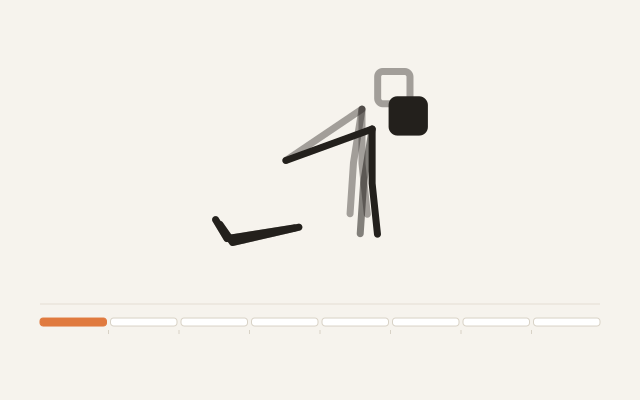
Seated cat and cow
Holding · both sides
10:00
1 / 8
Six rounds to move the segments before you ask them to turn. Small, continuous, hands on the knees.
8 steps · 10 min

Before you start
General movement information, not medical advice. Rotation that produces a sharp catch in the ribs, or pain that wraps around to the front of the chest, needs assessment before you continue.
Step table
StepHoldSideWhat you should feel
1. Seated cat and cow70s + 5sboth sidesSix rounds to move the segments before you ask them to turn. Small, continuous, hands on the knees.
2. Rotation, hands crossed65s + 10sright sideHands crossed on the chest, turn right, hold, breathe. The hands are crossed so that the arms cannot add range the ribs do not have.
3. Rotation, hands crossed70s + 5sleft sideSame to the left. Turn until you meet resistance, then stay there and breathe rather than pushing past it.
4. Chair twist with reach65s + 10sright sideRight hand on the chair back, left hand outside the right knee, turn right. The arms are a lever here — use them to hold, not to force.
5. Chair twist with reach70s + 5sleft sideLeft side. Keep both feet on the floor and both knees pointing forward — the moment a knee drifts out, the pelvis has joined in.
6. Open book65s + 10sleft sideLie on the left side, knees bent, arms together in front, then open the right arm across. Follow the hand with your eyes but keep the knees stacked.
7. Open book70s + 5sright sideRight side down, left arm opens. Let the top knee lift a few centimetres if it has to — a small loss of stacking for a much bigger turn is a good trade.
8. Seated breath with hands on ribs60s + 15sboth sidesSit tall, hands wrapped around the lower ribs, six slow breaths. Feel the ribs widen under your hands — that is the movement you just spent ten minutes making possible.

How to run this sequence

Rotation should come from the ribs

The test for every step here is whether the hips move. If they do, the rotation is coming from the lower back and the pelvis, which is where a mid-back that will not turn sends the load — and the lower back is exactly where you do not want it. Sit on the front of the chair, keep the knees pointing forward and the feet flat, and turn the ribcage above a still pelvis.

The four positions, and why the order matters

Each position changes which part of the mid-back is easiest to reach:

  • Hands crossed on the chest is the purest version — no arms involved, so nothing can fake the range.
  • Hand on the opposite knee adds a lever and gets more rotation, at the cost of some control.
  • The open book on the floor is the highest-range position because gravity assists, which is why it comes after the seated ones.
  • The breathing step at the end is not a stretch — it re-establishes rib movement in the position you just spent ten minutes earning.

Asymmetry is information, not a fault

Almost everyone has one direction with noticeably less rotation, and it is usually the side of the dominant hand. Note the difference rather than fighting it. Turning harder into the stiff side does not fix it; spending ten extra seconds there each day does. If the difference is new, large, or comes with pain, that is a different situation and belongs with a clinician rather than a stretching routine.

Questions about this sequence

Should the neck turn too, or stay still?

Keep the neck still and turn only the ribcage. If the head turns with the chest, the neck is supplying range that the mid-back does not have, which hides exactly what you are trying to measure.

Why does one side feel blocked?

Very common, and usually a combination of rib position, one-sided habits and the shape of the joints. Work the stiff side first, do the same number of repetitions on both sides regardless, and check again in three weeks rather than three minutes.

Can I do this in a chair with a back?

Yes, and a chair back is actually useful for one thing: pressing the lower back against it stops the pelvis from rotating. Sit forward enough that the contact is light, and turn above it.

Other sequences that pair well

Fifteen Minute Bedtime Spine and Hip Release — Preview rail

Fifteen Minute Bedtime Spine and Hip Release

15 min10 stepsGentleThoracic spineHips

Nothing here is meant to change your range. This sequence is about the thing that actually decides how you sleep: whether the body is still holding the day in its back and hips when you lie down. Every step is slow, every step ends lying or sitting, and the last one is chosen so that getting into bed afterwards is a two-second movement rather than a project.

Ten Minute Desk Break, Whole Body — Preview rail

Ten Minute Desk Break, Whole Body

10 min8 stepsGentleFull body

This is the sequence to run when you have been still for too long and nothing in particular hurts. It touches every area in the order the body asks for them — spine, hips, legs, shoulders — and it uses only a chair and a wall, so there is no reason for it not to happen. It is deliberately gentle: the goal is to interrupt stillness, not to train.

Ten Minute Standing Hip Circles — Preview rail

Ten Minute Standing Hip Circles

10 min8 stepsGentleHips

This is the sequence for the day you cannot lie down. Every step happens on your feet, which means the hip has to move while also holding you up — a different job from the same movement on a mat, and the one your hips actually do all day. The first half circles the joint through its full available range, the second half loads it at the end of that range.