Skip to the player
Unkink
timed stretching, cued by the second

Ten Minute Deep Glute Release

10 min8 stepsStandardHipsPublished 6 Oct 2026

The deep glute muscles sit under the big one and rotate the hip. They are also the muscles that most often get blamed for a pain that is actually coming from somewhere else — which is why this sequence spends its first steps on the positions that reliably change how the back of the hip feels, and its last steps on the movement that tells you whether it worked.

Cat and cow
Cat and cow
Holding · both sides
10:00
1 / 8
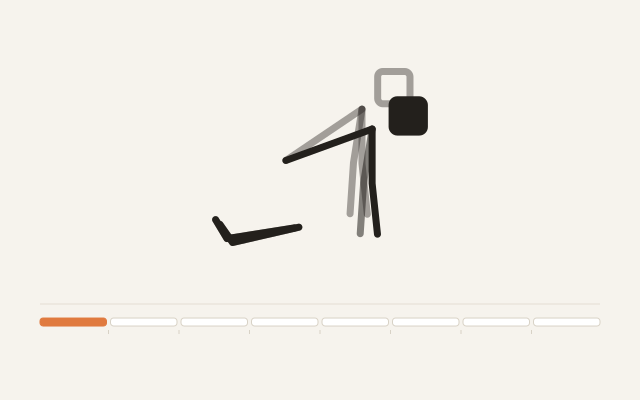
Five slow rounds. Note whether the back of the hip feels different on the two sides before you start — you need a starting point to compare against.
8 steps · 10 min

Before you start
General movement information, not medical advice. Pain that travels below the knee, comes with weakness, or changes with coughing or sneezing is a nerve signal, not a muscle one.
Step table
StepHoldSideWhat you should feel
1. Cat and cow70s + 5sboth sidesFive slow rounds. Note whether the back of the hip feels different on the two sides before you start — you need a starting point to compare against.
2. Supine figure four65s + 10sright sideRight ankle over the left knee, reach through, draw the legs in. Head and shoulders stay on the floor; the stretch should be a wide band across the right glute.
3. Supine figure four70s + 5sleft sideLeft ankle over the right knee. If the left knee complains, move the ankle closer to the hip — a tight ankle forces the knee to take the load.
4. Pigeon, upright65s + 10sleft sideLeft shin across, right leg back, hips level. Stay upright and breathe — folding forward here adds depth but also ends the rotation you are looking for.
5. Pigeon, upright70s + 5sright sideRight side. Keep the right foot flexed — a pointed foot at the back is how the calf and the knee get involved in a glute stretch.
6. Side lying top leg65s + 10sleft sideLie on the right side, left knee bent and drawn forward, then let the left shin drop toward the floor in front. Hold the ankle with the right hand if it needs the support.
7. Glute bridge70s + 5sboth sidesFeet down, lift the hips eight times slowly. The glutes have just been stretched — this step is what stops them from going quiet.
8. Supine twist65s + 10sright sideKnees to the right, left shoulder heavy, five breaths. Then bring the knees back through centre and stand up — notice whether the two hips feel the same.

How to run this sequence

What "piriformis" actually means

The piriformis is a small muscle that runs from the sacrum to the top of the thigh bone, and the sciatic nerve passes right next to it — sometimes through it. That anatomy is why deep glute symptoms can feel like they travel down the leg, and why the honest answer to "is it my piriformis" is usually "it is one of four things and the position that helps is the same for three of them". Work the positions, keep the ones that change the feeling, and let the diagnosis stay as loose as it needs to be.

Where the release actually happens

These positions work when the hip is rotated in the socket while the muscle is under mild tension, not when the leg is forced into an extreme shape:

  • The figure four and the pigeon both put the front hip into external rotation, which is the direction the deep glutes restrict.
  • The side-lying top leg step gets at the same muscles from a different angle and is the one people usually find the sensation in most precisely.
  • Keep the effort low. A hard stretch here makes the muscle guard, and a guarding muscle does not release.

When it is not the glutes at all

Three signs that the pain in the back of the hip is coming from the lower back rather than the muscle: it changes when you bend the neck or cough; it is worse in the morning and eases with walking; it comes with pins and needles anywhere below the knee. None of those are reasons to stop moving — but they are reasons to have it assessed before you spend three months stretching the wrong tissue.

Questions about this sequence

Should I use a ball to release this instead?

A ball is a strong, short stimulus that feels productive and changes little. Sitting on a ball for two minutes, then running this sequence, is a good combination — the ball takes the edge off and the sequence does the work. The ball alone, every day, is the version that stops helping.

Why does one side feel so different?

Almost always the side you stand on, sit on, or carry a bag on. Work the tighter side first in every step and do the same amount on both. Differences that are stable for years are just anatomy and habit; a difference that appeared in the last few weeks is worth a conversation with someone who can examine it.

Is it normal for the leg to go numb in pigeon?

No. Numbness or tingling down the leg means a nerve is being compressed, and the correct response is to come out of the position rather than to hold through it. Shorten the hold, reduce the range, and if it happens in every position, get it assessed.

Other sequences that pair well

Fifteen Minute Deep Squat Hold — Preview rail

Fifteen Minute Deep Squat Hold

15 min10 stepsDeepHips

The deep squat is the position that human hips are built to rest in and the one that most people in chairs have lost completely. This sequence does not try to get you into it by force; it spends twelve of its fifteen minutes removing the three things that stop you — a stiff ankle, a tight inner thigh, and a hip that will not rotate — and only then sits you down in the position with support. The last three minutes are spent getting out of it, which is the part that most sequences forget.

Ten Minute Brick Thoracic Extension — Preview rail

Ten Minute Brick Thoracic Extension

10 min8 stepsStandardThoracic spine

A brick under the mid-back turns extension from something you do with your lower back into something you can direct at one segment at a time. This sequence uses it in two ways — as a support to drape over while breathing, and as a fulcrum to move over — and pairs both with rotation, because a mid-back that can extend but not turn is still going to send the load somewhere else.

Fifteen Minute 90/90 Hip Flow — Preview rail

Fifteen Minute 90/90 Hip Flow

15 min10 stepsStandardHips

The 90/90 position puts both hips at a right angle at the same time, which is the one shape that trains internal and external rotation together rather than one after the other. This sequence builds from the basic switch into the positions that use it — pigeon, lunge, frog — and back, with a glute bridge in the middle to make sure the hip is still doing work rather than only being stretched.