Skip to the player
Unkink
timed stretching, cued by the second

Ten Minute Brick Roll for the Mid Back

10 min8 stepsStandardThoracic spinePublished 16 Oct 2026

Instead of holding one position, this sequence moves the support down the mid-back one segment at a time and works each one briefly. That is a different stimulus from a single long extension: it reaches segments that a single brick position never touches, and it teaches the mid-back to move through extension rather than simply to arrive in it and stay.

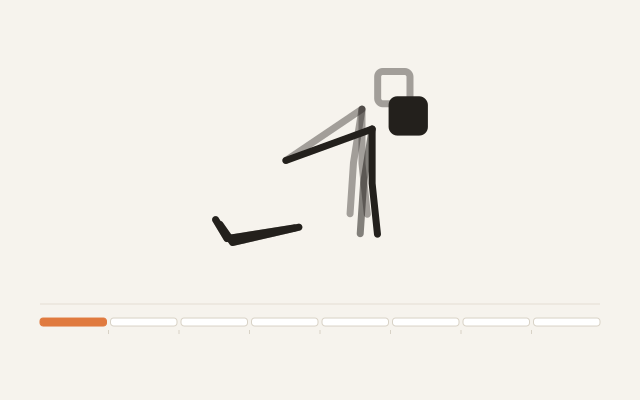
Cat and cow
Cat and cow
Holding · both sides
10:00
1 / 8
Six rounds, and pay attention to which segments move. You are about to spend the next ten minutes on the ones that do not.
8 steps · 10 min

Before you start
General movement information, not medical advice. Rib pain, a known vertebral fracture, or mid-back pain that is worse at night or comes with unexplained weight loss needs medical assessment first.
Step table
StepHoldSideWhat you should feel
1. Cat and cow70s + 5sboth sidesSix rounds, and pay attention to which segments move. You are about to spend the next ten minutes on the ones that do not.
2. Brick roll, lowest segments65s + 10sboth sidesBrick at the bottom of the mid-back, hands supporting the head, four slow breaths. This is usually the stiffest place — expect it to feel the strongest.
3. Brick roll, middle segments70s + 5sboth sidesSlide two centimetres up the mat, three breaths here, then up again. The middle moves more easily and needs less time.
4. Open book65s + 10sleft sideLie on the left side, brick away, knees bent and stacked, right arm opening across. Extension followed by rotation — this is the pair the mid-back needs.
5. Open book70s + 5sright sideRight side down, left arm opening. Let the top knee slide forward a little if the rotation is blocked — a few centimetres of stacking is a small price.
6. Thread the needle65s + 10sleft sideLeft arm under, shoulder and temple down. A different angle on the same rotation, and it reaches closer to the shoulder blade.
7. Sphinx70s + 5sboth sidesForearms down, front ribs drawing back, legs heavy. This is the unsupported test: how much of the range you just built can you hold on your own.
8. Child's pose with reach65s + 10sboth sidesSit back to the heels, arms forward, back rounding completely. Always finish extension work with flexion — the segments need to go back the other way.

How to run this sequence

Roll, do not drop

The brick is moved by sliding the body over it, not by lifting the hips and repositioning. Lift, place, lower, and you lose contact with the segment you were working and startle everything you just relaxed. Put the brick on the mat first, then slide down and over it, then slide up. Two or three centimetres at a time is the right increment and it means eight to ten positions in the ten minutes.

What each position is for

The mid-back is twelve segments and they do not all behave the same way:

  • The lowest two or three are usually the stiffest in people who sit, and they are the ones to spend the most time on.
  • The middle segments move more freely and need less; twenty seconds each is plenty there.
  • The top two sit under the shoulder blades and are reached better by the open book than by the brick, which is why rotation steps follow the roll.
  • Stop before the brick reaches the neck. The joint at the top of the thoracic spine does not need this and will not thank you for it.

The breathing is the point

At each position, the extension range is created by the exhale: breathe in and the ribs lift, breathe out and the segments settle around the brick. That is why the holds here are counted in breaths rather than seconds, and why rushing through the positions reduces this to lying on a hard object for ten minutes. Four or five slow breaths per position, and the movement happens whether or not you push.

Questions about this sequence

Can I do this with a foam roller instead?

A roller is longer and softer, which makes it easier to roll along and harder to target a single segment. It is a fine substitute for the middle of this sequence and a poor one for the low, stiff segments where the brick does its best work.

Should I feel it in the lower back at all?

No. If the lower back is arching or complaining, the brick has gone too low or the ribs are not drawing down. Move the brick up one position and bend the knees so the pelvis can tilt.

How often should I move the brick?

Two or three centimetres at a time, in one direction, once through the sequence. Going up and down repeatedly is a popular way to do this and it tends to leave the mid-back irritated rather than opened.

Other sequences that pair well

Ten Minute Deep Glute Release — Preview rail

Ten Minute Deep Glute Release

10 min8 stepsStandardHips

The deep glute muscles sit under the big one and rotate the hip. They are also the muscles that most often get blamed for a pain that is actually coming from somewhere else — which is why this sequence spends its first steps on the positions that reliably change how the back of the hip feels, and its last steps on the movement that tells you whether it worked.

Ten Minute Brick Thoracic Extension — Preview rail

Ten Minute Brick Thoracic Extension

10 min8 stepsStandardThoracic spine

A brick under the mid-back turns extension from something you do with your lower back into something you can direct at one segment at a time. This sequence uses it in two ways — as a support to drape over while breathing, and as a fulcrum to move over — and pairs both with rotation, because a mid-back that can extend but not turn is still going to send the load somewhere else.

Ten Minute Seated Thoracic Rotation — Preview rail

Ten Minute Seated Thoracic Rotation

10 min8 stepsGentleThoracic spine

Rotation is the movement the mid-back is built for and the one it loses first. A seated sequence can train it all day long because rotation is the one direction you can work without standing up or lying down. This one takes ten minutes and treats rotation as the main event rather than as a step at the end of a stretching routine — two directions, four positions, and a breathing step to finish.