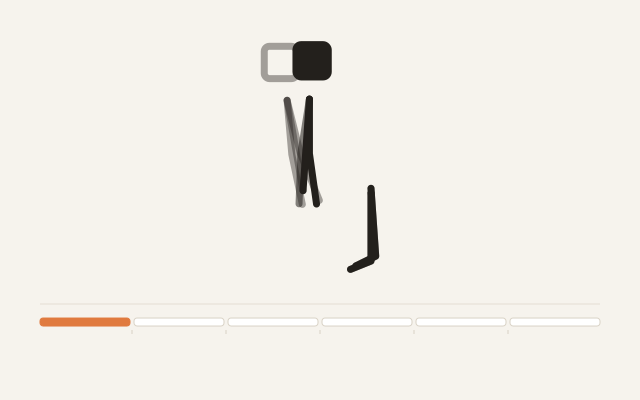
No mat, no floor, no standing up. This is the fastest sequence in the library and it is designed to be done with one hand on the chair and the other still holding a pen. It works the neck in the four directions it actually moves, anchors the shoulder for each of them, and finishes with the two minutes of shoulder movement that make the neck part hold.
Chin tuck
Holding · both sides
5:00
1 / 6
Sit tall, make a double chin, hold five seconds, release. Eight times. It looks like nothing and it is the most useful step here.
6 steps · 5 min
Before you start General movement information, not medical advice. Neck pain with dizziness, nausea, visual changes, arm numbness, or after an accident needs urgent medical assessment.
Step table
Step
Hold
Side
What you should feel
1. Chin tuck
45s + 5s
both sides
Sit tall, make a double chin, hold five seconds, release. Eight times. It looks like nothing and it is the most useful step here.
2. Neck tilt, right
45s + 5s
right side
Sit on the left hand to anchor the shoulder, tilt the head right. Face stays forward, and the pull should be wide rather than sharp.
3. Neck tilt, left
45s + 5s
left side
Sit on the right hand, tilt left. Breathe out slowly as you settle into it — the exhale does most of the lengthening.
4. Quick neck turn
45s + 5s
both sides
Turn the head right, hold five seconds, then left, and repeat. Small and quick — this is the step that fits between two sentences of an email.
5. Shoulder rolls
45s + 5s
both sides
Ten rolls each way, as big as the chair allows, breathing out on the way down. This is what makes the neck steps last longer than the five minutes.
6. Anchored upper trap lean
35s + 15s
both sides
One hand under the chair seat, tilt the head away and hold. Then swap. Finish here, sit back, and notice whether the shoulders are lower than when you started.
How to run this sequence
The four directions, and the one to skip
A neck moves forward, back, to each side and in rotation. Three of those are safe to work at a desk in the middle of a working day, and one is not:
Side bending and rotation are the two that tightens up most during desk work and the two that respond fastest.
Forward (chin tuck) is the direction that undoes a forward head and is worth doing more often than the others.
Backward extension is the one to keep small. A full backward tilt at the top of the neck is the movement most likely to produce a problem, and it is not needed here.
There is no full circle in this sequence and there should not be one in any neck routine.
Why it is written to be done twice
Five minutes twice a day beats ten minutes once, for the same reason five minutes of hip work daily beats a weekend session: the tissue never gets long enough to return to its starting shape. If you do this twice, the second time in the afternoon is the more valuable one, because that is when the shoulders have had a full day to creep up.
If your neck is currently painful
A neck that is painful at rest, or one that has been getting worse over days, is not a candidate for a routine — it needs a person who can examine it. What this sequence is for is the ordinary version: a neck that feels stiff and tired, moves better when you move it, and is worse at the end of a long day. That is the version almost everyone has, and it is the version this five minutes is aimed at.
Questions about this sequence
How hard should I pull?
Barely. With the shoulder anchored, the weight of the head alone is usually enough, and adding a hand should add a suggestion rather than a force. If you are pulling hard enough that the neck muscles tighten up to resist, you have gone past the point where this helps.
Can I do it while reading email?
The neck steps, yes, roughly. The shoulder steps need enough attention that reading will undo them. Do the neck steps while reading and the shoulder steps between things — that split is a reasonable way to use this on a busy day.
Is it bad to crack my neck?
The occasional painless release is not dangerous, but doing it repeatedly, deliberately, several times a day is a sign the neck is being managed rather than moved. The five minutes here is the more useful version of the same urge.
The upper trapezius is the muscle that holds your head up all day and the one that a desk worker can feel without looking for it. Five minutes of gentle, anchored work will not undo a decade of it, but it reliably takes the edge off — provided you stop trying to stretch the neck from the neck alone. Every step here anchors the shoulder first, because a trapezius that is being pulled from both ends does not lengthen.
An ankle that cannot bend forward properly changes everything above it: the knee tracks badly, the hip takes a longer stride than it wants, and the calf works overtime on every step. This ladder measures the ankle first, then moves it in the two directions it actually needs — forward over the toes, and up and down through the heel — and finishes by putting weight through the new range so it stays.
The shoulder blade is a bone that floats on the back of the ribcage and is supposed to slide upward, downward and around it. A day of typing holds it in one place for hours, and the muscles that normally move it stop being asked. This sequence spends five minutes asking, in a small range, with almost no load — which is exactly what a shoulder that has been still all day can accept.