Five minutes, one wall, and no floor work at all. This is the version to do when you are dressed for something else, in a corridor, or waiting for a kettle — the version that actually happens on the days the mat does not come out. It runs straight-leg and bent-knee work on both sides, then loads the new range with a slow calf raise.
Wall calf, straight leg
Holding · left side
5:00
1 / 6
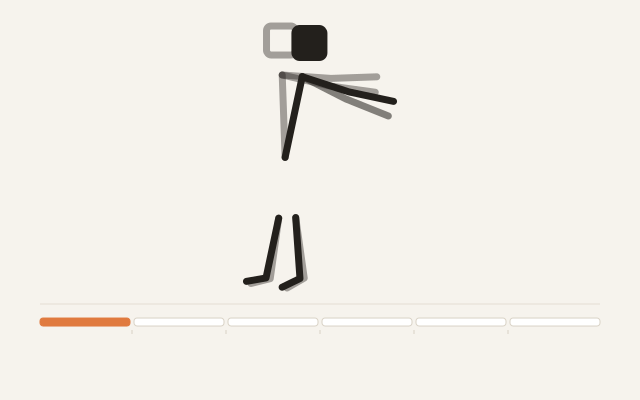
Left leg back, straight knee, heel pressing down, toes straight ahead. The line should run from behind the knee all the way to the heel.
6 steps · 5 min
Before you start General movement information, not medical advice. Calf pain that came on suddenly during activity, or a calf that is swollen, warm or tender, needs urgent assessment — not stretching.
Step table
Step
Hold
Side
What you should feel
1. Wall calf, straight leg
45s + 5s
left side
Left leg back, straight knee, heel pressing down, toes straight ahead. The line should run from behind the knee all the way to the heel.
2. Wall calf, straight leg
45s + 5s
right side
Right leg back. Same setup, and check the back foot has not drifted outward — it is the most common thing to lose between sides.
3. Wall calf, bent knee
45s + 5s
left side
Left leg back with the knee bent and the heel still down. Expect this lower, closer to the achilles — that is the soleus, and it is the one standing tightens.
4. Wall calf, bent knee
45s + 5s
right side
Right side, bent knee. Keep pressing the heel — the bent knee is not permission to come out of the stretch.
5. Standing reach and heel drop
45s + 5s
both sides
Reach both arms up, rise onto the toes, then lower the heels slowly and further than they started. Three repetitions, very slow.
6. Loaded calf raise
35s + 15s
both sides
Ten slow calf raises, up over three seconds and down over four. Finish here — the calf should end the sequence working, not just stretched.
How to run this sequence
The two-minute version of a ten-minute problem
Calves respond to total time under tension more than to any particular technique. Five minutes a day beats thirty minutes once a week, because the tissue never gets long enough to set back to where it started. If five minutes is still too much on a given day, the two steps that carry the most value are the straight-leg wall calf and the bent-knee version — do those on both sides and you have done most of the work in two minutes.
Getting the back foot straight
The single biggest reason a standing calf stretch does not work is the back foot turning out. Check it in this order:
Point the back toes straight at the wall, not out to the side. Turned out by even twenty degrees and the stretch moves to the inside of the ankle.
Keep the back knee straight in the straight-leg version. It is the only joint position that puts the gastrocnemius under tension.
Press the heel down and slightly back rather than pushing the body forward. Pressing is what the muscle responds to.
Keep the front knee over the front ankle rather than ahead of the toes, so the whole body does not creep forward of the back heel.
What to do when it does not want to let go
A calf that has been tight for years usually has a stiff ankle feeding it, and no amount of stretching the muscle will change that. The test is the knee-to-wall distance: if the knee cannot get within about seven centimetres of the wall with the heel down, work the ankle joint as well. The wall-and-calf press and the ankle ladder in this library both do that. Muscle work alone on a joint problem is the most common reason people report that "nothing works".
Questions about this sequence
How long should each side get?
Forty-five seconds is the minimum worth doing and ninety is the point of diminishing returns for most people. The sequence is built around forty-five second holds because it is designed to be finished, not to be optimal.
Is it better to do this before or after walking?
After. A long hold before walking reduces the reflex that protects the ankle, and the ankle has to absorb the next few thousand steps. Before a walk, do the slow calf raises instead and leave the holds for afterwards.
Should I feel it in the arch of the foot?
A pull through the sole of the foot means the foot is taking the stretch instead of the calf, which usually means the heel has lifted or the toes have turned out. Flatten the foot, press the heel down, and try again.
This is the standing version of the calf work: five minutes, a wall and a step, no mat and no floor. It uses the wall for two different jobs — as a surface to press the heel into for the straight-leg work, and as something to hold for the balance-demanding versions — and it goes at the calves in the order that works: straight leg, then bent knee, then load.
An ankle that cannot bend forward properly changes everything above it: the knee tracks badly, the hip takes a longer stride than it wants, and the calf works overtime on every step. This ladder measures the ankle first, then moves it in the two directions it actually needs — forward over the toes, and up and down through the heel — and finishes by putting weight through the new range so it stays.
The two muscles on the back of the leg are continuous in how they behave: a calf that tightens pulls on the hamstring through the pelvis, and a hamstring that will not lengthen makes the calf work harder on every stride. This sequence is built for after a run, when the tissue is warm and the sequence can afford to be specific. It starts at the ankle, moves up to the back of the knee, and finishes with the long line from the sit bone to the heel.