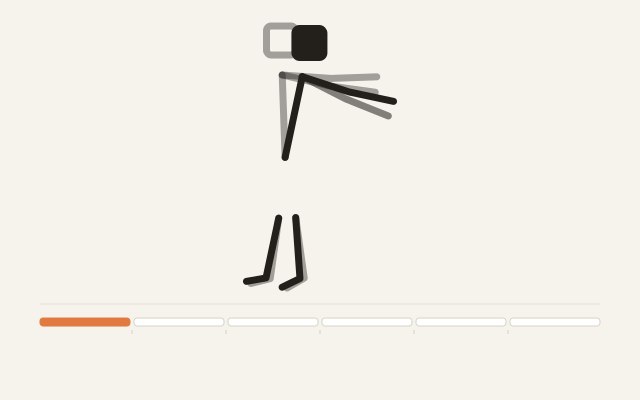
This is the standing version of the calf work: five minutes, a wall and a step, no mat and no floor. It uses the wall for two different jobs — as a surface to press the heel into for the straight-leg work, and as something to hold for the balance-demanding versions — and it goes at the calves in the order that works: straight leg, then bent knee, then load.
Wall calf, straight leg
Holding · left side
5:00
1 / 6
Left leg back, knee straight, heel pressing down and slightly back. Toes pointing straight ahead, not turned out.
6 steps · 5 min
Before you start General movement information, not medical advice. A calf that is swollen, hot or painful to touch, or an achilles that is sore in the morning and takes twenty minutes to warm up, should be assessed first.
Step table
Step
Hold
Side
What you should feel
1. Wall calf, straight leg
45s + 5s
left side
Left leg back, knee straight, heel pressing down and slightly back. Toes pointing straight ahead, not turned out.
2. Wall calf, straight leg
45s + 5s
right side
Right leg back. Press rather than lean — the heel does the work and the body stays over the front foot.
3. Knee to wall
45s + 5s
left side
Left heel down, left knee toward the wall. Keep the arch of the foot lifted — a collapsing arch eats about a centimetre of the range you are measuring.
4. Wall calf, bent knee
45s + 5s
right side
Right leg back with the knee bent and the heel down. Keep the heel pressed; the bent knee is not an excuse to come out of the stretch.
5. Loaded calf raise
45s + 5s
both sides
Both feet, rise over three seconds, hold two, lower over four. Ten repetitions, and use the wall for balance only, not for support.
6. Stair drop
35s + 15s
both sides
Balls of the feet on the step edge, heels dropping below slowly and rising back level. Finish here — the last thing the calf does is work through the range it just gained.
How to run this sequence
Press, do not lean
The difference between a calf stretch that works and one that does nothing is whether the heel is actively pressing down or the body is passively leaning in. Pressing the heel down and slightly back engages the calf while it lengthens, which is the stimulus that changes the tissue. Leaning in just compresses the ankle. If you cannot tell which one you are doing, lift the heel a centimetre off the floor and press it down again slowly — the difference will be obvious.
Straight leg, then bent, in that order
The two calves need different knee positions and the order matters:
Straight leg reaches the gastrocnemius, the visible one, and it needs to be done first so the surface muscle is not blocking the deeper one.
Bent knee reaches the soleus, which sits under it and is the one that tightens from standing rather than from running.
Loaded work (the calf raise and the stair drop) comes last, so the new range is used immediately rather than collected and put away.
Where people lose the stretch
Three things kill a wall calf stretch, and all three are invisible unless you look: the back foot turns out, the back knee bends in the straight-leg version, and the front knee travels past the toes so the whole body is forward of the back heel. Check all three before you start holding, because a calf stretch held at the wrong angle for fifty seconds teaches the calf nothing except how to wait.
Questions about this sequence
Should I hold my breath?
People do, particularly in the loaded steps, without noticing. Breathe out slowly as you press the heel down and keep the exhale going for about four seconds. If you cannot, the position is harder than it needs to be — reduce it.
How is this different from the ankle ladder?
The ankle ladder is aimed at the joint — forward range over the toes, measured with the knee to wall. This one is aimed at the muscle, held longer and loaded at the end. Doing both in a week is a good pattern; doing both on the same day is unnecessary.
Can I do this in shoes?
Only the standing steps, and only if the shoes have a flat sole. The stair drop needs the foot to be able to drop below the step, which a heel makes impossible. Barefoot is better for the whole sequence if the floor allows it.
Five minutes, one wall, and no floor work at all. This is the version to do when you are dressed for something else, in a corridor, or waiting for a kettle — the version that actually happens on the days the mat does not come out. It runs straight-leg and bent-knee work on both sides, then loads the new range with a slow calf raise.
An ankle that cannot bend forward properly changes everything above it: the knee tracks badly, the hip takes a longer stride than it wants, and the calf works overtime on every step. This ladder measures the ankle first, then moves it in the two directions it actually needs — forward over the toes, and up and down through the heel — and finishes by putting weight through the new range so it stays.
The two muscles on the back of the leg are continuous in how they behave: a calf that tightens pulls on the hamstring through the pelvis, and a hamstring that will not lengthen makes the calf work harder on every stride. This sequence is built for after a run, when the tissue is warm and the sequence can afford to be specific. It starts at the ankle, moves up to the back of the knee, and finishes with the long line from the sit bone to the heel.