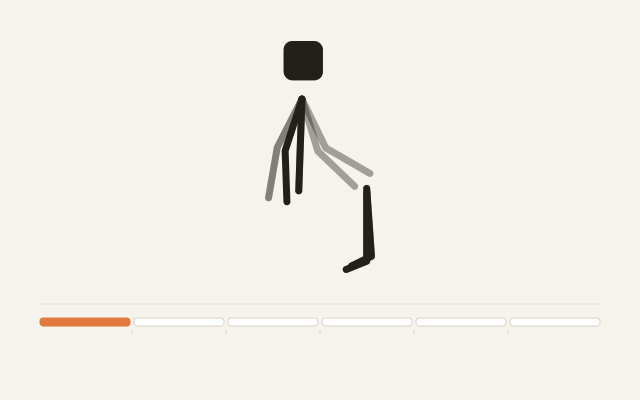
Six steps, fifty seconds each, done sitting in the chair you are already in. Nothing here pulls hard: the point is to move the neck through the four directions it stopped using while you were reading a screen, and to let the shoulder blades drop back down. If you only have one sequence for a working day, this is the one to keep on the rail.
Shoulder roll
Holding · both sides
5:00
1 / 6
Ten slow circles, drawing the shoulder blade down and back before it comes up again — the descent is the part that matters.
6 steps · 5 min
Before you start General movement information, not medical advice. Stop at the first sign of pain, numbness, tingling or dizziness, and see a clinician about a neck that has been painful for more than a couple of weeks, or after any impact.
Step table
Step
Hold
Side
What you should feel
1. Shoulder roll
45s + 5s
both sides
Ten slow circles, drawing the shoulder blade down and back before it comes up again — the descent is the part that matters.
2. Seated neck tilt
40s + 10s
left side
Left ear toward the left shoulder, no hand pressure. The pull should be a wide band on the right side of the neck, not a point.
3. Seated neck tilt
45s + 5s
right side
Right ear toward the right shoulder. Keep the left shoulder heavy — if it rises, the stretch has moved to the wrong side.
4. Seated neck turn
40s + 10s
both sides
Turn the head level — chin stays horizontal, chin stays down. A short warm pull at the side of the neck, never a pinch at the back.
5. Ear toward shoulder
45s + 5s
left side
Small drop of the left ear, then slide the right shoulder blade down the ribs. The stretch appears between the shoulder blade and the spine.
6. Chin tuck and nod
35s + 15s
both sides
Draw the chin back as if you were making a double chin, then nod slowly twice. The back of the neck lengthens instead of arching.
How to run this sequence
Why the order is tilt, turn, ear, nod
The neck tightens unevenly. The upper fibres of trapezius (the slope from neck to shoulder) usually win over the deep flexors at the front, which is why the head drifts forward and the chin lifts. Working side-bend first releases the slope; turning second restores rotation while the slope is still long; the ear-to-shoulder hold then reaches the fibres between the shoulder blade and the spine; the chin nod at the end re-finds the small nodding movement most people have lost. Doing the nod first would just pull on tissue that has not let go yet.
How hard to go
On a scale where 0 is nothing and 10 is "stop immediately", stay between 3 and 4 for the whole five minutes. A neck stretch should feel like a wide, warm pull that fades after about twenty seconds, not like a wire tightening.
Keep the shoulders down and let the arm you are not using rest on your thigh — do not add your hand's weight to the head.
Breathe out slowly through the four or five seconds of each transition; that is when the tissue actually gives.
If a direction produces a pinching feeling at the base of the skull rather than a stretch, halve the range and go again.
What "done" feels like afterwards
The test is not how far the head turns. It is whether turning it takes less effort than it did five minutes ago, and whether the space between the shoulder blades feels wider. If the neck instead feels tired or the head heavy, you went too hard — next time stop each step at the first sign of the pull rather than chasing more range.
Questions about this sequence
Should I do this before or after the screen work that caused it?
Both, if you can. The five minutes before you start protects the next two hours, and the same five minutes at the end of the day stops the tension from following you home. If you only do it once, do it mid-afternoon, when cumulative sitting is at its worst.
Can I do it at a desk where nobody should see me stretching?
Every step in this sequence is small enough to be invisible from two metres away: no arms overhead, no leaning over the chair, no floor work. The largest movement is the head tilting about a hand's width to the side.
What if turning my head makes me dizzy?
Stop the turn steps and keep only the tilts and the nod. Dizziness with neck rotation can come from the inner ear or from the upper neck, and it is one of the few things a website should not talk you through. If it happens more than once, have it looked at.
The shoulder blade is a bone that floats on the back of the ribcage and is supposed to slide upward, downward and around it. A day of typing holds it in one place for hours, and the muscles that normally move it stop being asked. This sequence spends five minutes asking, in a small range, with almost no load — which is exactly what a shoulder that has been still all day can accept.
A wall gives you something a floor cannot: instant feedback. If your mid-back does not move, the wall will not let you pretend otherwise, because your lower back has to lift off it. This sequence uses that feedback to open the front of the chest and the front of the shoulders — the two places that a day of typing pulls forward and holds there.
Everything here happens without standing up. The spine is moved through flexion, side bending and rotation in the order that a stiff back tolerates them, and the whole sequence fits in the gap between two meetings. It does not replace a floor practice, but five seated minutes done three times a day beats thirty floor minutes done once and then abandoned.