Skip to the player
Unkink
timed stretching, cued by the second

Five Minute Deep Calf and Achilles Work

5 min6 stepsDeepCalves & anklesPublished 22 Oct 2026

The stair drop is the strongest calf stretch there is, because it puts the full body weight through the ankle at the end of its range. That makes it effective and it makes it the one to be careful with. This five-minute version spends its first half preparing the tissue with slow, loaded repetitions and its second half in the drop itself, held only as long as the achilles stays comfortable.

Slow two-foot calf raise
Holding · both sides
5:00
1 / 6
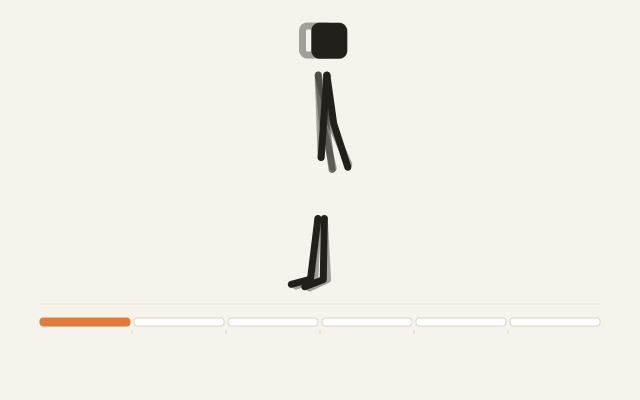
Ten repetitions, up over three seconds, down over four, both feet. Load before length — this is the step that makes the rest safe.
6 steps · 5 min

Before you start
General movement information, not medical advice. Sudden calf pain with a feeling of something snapping, or an achilles that is swollen or thickened, needs urgent assessment, not exercise.
Step table
StepHoldSideWhat you should feel
1. Slow two-foot calf raise45s + 5sboth sidesTen repetitions, up over three seconds, down over four, both feet. Load before length — this is the step that makes the rest safe.
2. Wall calf, straight leg45s + 5sleft sideLeft leg back, knee straight, heel pressing down. Hold this one shorter than usual — it is preparation for the drop, not the main event.
3. Wall calf, straight leg45s + 5sright sideRight leg back. Check the back foot is pointing straight at the wall — turned out, and the ankle rather than the calf takes the load.
4. Stair drop, both feet45s + 5sboth sidesBoth feet on the edge, heels dropping together over four seconds and rising back up. Eight slow repetitions rather than one long hold.
5. Stair drop, held45s + 5sboth sidesOne hold at the bottom, both feet, only as long as the achilles stays comfortable. If it starts to ache rather than stretch, come up immediately.
6. Knee to wall to finish35s + 15sboth sidesMeasure both ankles to finish, then walk slowly for a minute. The number afterwards compared to before tells you what this session actually did.

How to run this sequence

Load first, stretch second

A tendon responds to load, not to being pulled. The calf raise steps at the start are not a warm-up in the vague sense — they are the actual stimulus for the achilles, and the drop that follows works because the tissue has already been through a range of contractions. Skipping to the drop is the version that produces a sore achilles the next morning.

Two feet, always, at this level

The single-leg version of a stair drop puts roughly twice the body weight through one achilles and is where most people get into trouble:

  • Both feet on the step edge, weight shared, heels dropping together.
  • Lower slowly over four seconds. The slow lowering is the exercise; the position at the bottom is just where it happens.
  • Come up onto the toes to finish each repetition rather than simply returning to level — a full repetition is down and back up.
  • The single-leg version belongs only after months of the two-foot version with no morning soreness at all.

Achilles rules

Three things that should stop the sequence immediately: pain in the achilles that is worse when you first put weight on it in the morning than it was the day before; a sudden sharp pain with a feeling of something giving way; and swelling or a thickening of the tendon that is new. The first is the classic sign of overdoing it and it means backing off for a week, not pushing through. The second and third need medical assessment. A tendon that is merely stiff for the first few steps of the day and loosens up is a different, much more manageable situation.

Questions about this sequence

Is a step necessary, or can I use a book?

Anything with a stable edge works — a thick book, a low step, the bottom stair. What matters is that the edge does not move and that the drop is enough to feel a stretch without being so deep that the heel goes far below the toes.

How much should it hurt?

It should not hurt at all. A strong stretch is fine and normal; pain in the tendon itself is not, and neither is anything sharp. Tendons that are being worked correctly feel loaded, not painful, and they feel the same or better the next morning.

How do I know I am making progress?

Two markers: the heel goes lower before the sensation becomes strong, and the morning stiffness after a hard session is shorter. If neither is changing after a month, the dose needs adjusting rather than increasing.

Other sequences that pair well

Five Minute Standing Calf Stretch — Preview rail

Five Minute Standing Calf Stretch

5 min6 stepsStandardCalves & ankles

Five minutes, one wall, and no floor work at all. This is the version to do when you are dressed for something else, in a corridor, or waiting for a kettle — the version that actually happens on the days the mat does not come out. It runs straight-leg and bent-knee work on both sides, then loads the new range with a slow calf raise.

Five Minute Wall and Calf Press — Preview rail

Five Minute Wall and Calf Press

5 min6 stepsStandardCalves & ankles

This is the standing version of the calf work: five minutes, a wall and a step, no mat and no floor. It uses the wall for two different jobs — as a surface to press the heel into for the straight-leg work, and as something to hold for the balance-demanding versions — and it goes at the calves in the order that works: straight leg, then bent knee, then load.

Five Minute Ankle Mobility Ladder — Preview rail

Five Minute Ankle Mobility Ladder

5 min6 stepsGentleCalves & ankles

An ankle that cannot bend forward properly changes everything above it: the knee tracks badly, the hip takes a longer stride than it wants, and the calf works overtime on every step. This ladder measures the ankle first, then moves it in the two directions it actually needs — forward over the toes, and up and down through the heel — and finishes by putting weight through the new range so it stays.