Skip to the player
Unkink
timed stretching, cued by the second

Fifteen Minute Hamstring Belt Series

15 min10 stepsGentleHamstringsPublished 24 Sep 2026

Every step in this sequence uses a belt, which means every step can be done without the lower back helping and without the hands pulling. That makes it the right sequence for the two situations a straight hamstring stretch does not fit: a lower back that complains when you fold, and hamstrings that guard the moment they are asked to lengthen against body weight. Ten steps, ninety seconds each, and the belt does most of the work.

Cat and cow
Cat and cow
Holding · both sides
15:00
1 / 10
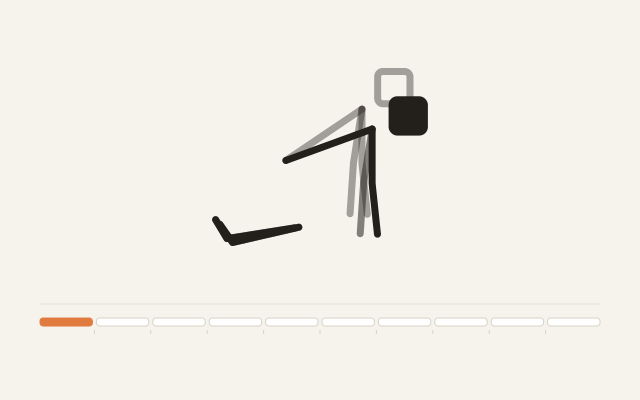
Five slow rounds to wake the spine up before you lie on it. Keep the movement in the mid-back rather than the hips.
10 steps · 15 min

Before you start
General movement information, not medical advice. A hamstring that tingles or burns rather than stretches, or one with a recent strain, should be assessed before this sequence is used.
Step table
StepHoldSideWhat you should feel
1. Cat and cow85s + 5sboth sidesFive slow rounds to wake the spine up before you lie on it. Keep the movement in the mid-back rather than the hips.
2. Supine belt, knee bent85s + 5sleft sideLeft leg up with the knee bent, belt over the arch. Start here rather than with a straight leg — the bent version tells you where the limit actually is.
3. Supine belt, knee bent85s + 5sright sideRight leg. Keep the left heel dragging on the floor and the left knee pointing at the ceiling — that is what stops the pelvis rolling.
4. Supine belt, leg straight85s + 5sleft sideStraighten the left knee as far as it goes while the sit bone stays down. Where the sit bone lifts is the end of the range, not where the leg stops.
5. Supine belt, leg straight85s + 5sright sideRight side, straight. Do not add a second hand to the belt to go further — two hands pulling is the version of this exercise that does not work.
6. Seated belt hamstring85s + 5sleft sideSit tall with the left leg long, belt over the arch. Keep the spine upright and let the leg come to you — a rounded back here undoes the point of the sequence.
7. Seated belt hamstring85s + 5sright sideRight leg. Sit on a folded mat if the pelvis rolls back — a tipped pelvis makes this a lower-back stretch with a leg attached.
8. Doorway hamstring85s + 5sleft sideLie on your back in a doorway, left leg up the frame, right leg through it flat. The doorway holds the leg so your arms can do nothing at all.
9. Doorway hamstring85s + 5sright sideRight leg up the frame. Slide the hips closer to the doorway to increase the angle, further away to reduce it — that is the whole control.
10. Supported half split80s + 10sboth sidesFinish kneeling, hands on two bricks, front leg straight. The last step before you stand up — the bricks are there so the finish is not a collapse.

How to run this sequence

The belt takes the back out of it

In a standing or seated fold, the amount of hamstring stretch is decided by how far the pelvis can tip — and if the pelvis will not tip, the lower back bends instead. Lying down with a belt removes that trade entirely: the back stays flat on the floor, the pelvis stays neutral, and the only variable left is how far the leg goes. That is why this is the version to run when folding makes your lower back sore.

Three rules for the belt

The belt is easy to use badly, and every failure looks the same — pulling with the arms:

  • Loop it over the arch of the foot, never over the toes.
  • Hold the ends with a straight arm and let the leg come toward you by relaxing, not by hauling. If your elbow is bending, you are pulling.
  • Keep the free leg heavy and long on the floor. The free leg is what keeps the pelvis neutral and makes the whole thing work.
  • Breathe out on the way into the range and stop where the breath is still easy to hold.

Gentle does not mean ineffective

Because nothing here loads the tissue heavily, this sequence can be run daily, which matters more than intensity for range work. The trade is time: ninety seconds per step is longer than the standard holds elsewhere in the library, and the change shows up over weeks rather than in one session. If you have only five minutes, run the two supine steps and the doorway step — those three carry most of the value.

Questions about this sequence

What if I do not have a belt?

A towel, a dressing gown cord, a dog lead or a pair of tights knotted together all work. What matters is that it is not stretchy — an elastic band makes it impossible to tell how much of the tension is you pulling.

My hands go numb holding the belt — what now?

Common, and it means you are gripping hard enough to compress the wrist. Hold the belt with a relaxed hand and let the arm rest on the floor beside you, or take the belt over the shoulder instead of holding it overhead.

Is it better before or after other training?

After, or on its own in the evening. The long, relaxed holds in this sequence quiet the reflex that protects the hamstring, so doing it immediately before sprinting or lifting is the wrong order — use the active lunge and hip circle steps from the other sequences as a warm-up instead.

Other sequences that pair well

Ten Minute Doorway Hamstring Sequence — Preview rail

Ten Minute Doorway Hamstring Sequence

10 min8 stepsGentleHamstrings

A doorway does something no strap can: it holds the leg for you. Put one leg up the frame, lie back, and the hamstring is under a long, steady, hands-free stretch that you can stay in for a minute and a half without your arms getting tired or your lower back joining in. This sequence uses that property for its whole first half and then checks the new range in a seated fold.

Fifteen Minute Bedtime Spine and Hip Release — Preview rail

Fifteen Minute Bedtime Spine and Hip Release

15 min10 stepsGentleThoracic spineHips

Nothing here is meant to change your range. This sequence is about the thing that actually decides how you sleep: whether the body is still holding the day in its back and hips when you lie down. Every step is slow, every step ends lying or sitting, and the last one is chosen so that getting into bed afterwards is a two-second movement rather than a project.

Fifteen Minute Post-Run Calf and Hamstring — Preview rail

Fifteen Minute Post-Run Calf and Hamstring

15 min10 stepsStandardCalves & anklesHamstrings

The two muscles on the back of the leg are continuous in how they behave: a calf that tightens pulls on the hamstring through the pelvis, and a hamstring that will not lengthen makes the calf work harder on every stride. This sequence is built for after a run, when the tissue is warm and the sequence can afford to be specific. It starts at the ankle, moves up to the back of the knee, and finishes with the long line from the sit bone to the heel.