Skip to the player
Unkink
timed stretching, cued by the second

Ten Minute Doorway Hamstring Sequence

10 min8 stepsGentleHamstringsPublished 8 Oct 2026

A doorway does something no strap can: it holds the leg for you. Put one leg up the frame, lie back, and the hamstring is under a long, steady, hands-free stretch that you can stay in for a minute and a half without your arms getting tired or your lower back joining in. This sequence uses that property for its whole first half and then checks the new range in a seated fold.

Cat and cow
Cat and cow
Holding · both sides
10:00
1 / 8
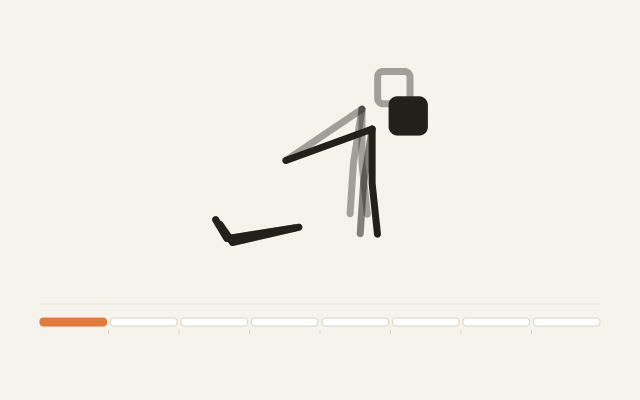
Six slow rounds on the mat in front of the doorway. It is the only warm-up this sequence needs and it makes the first hold much easier.
8 steps · 10 min

Before you start
General movement information, not medical advice. A hamstring with a recent tear, or one that produces a sharp, localised pain near the sit bone, should be assessed before this sequence.
Step table
StepHoldSideWhat you should feel
1. Cat and cow70s + 5sboth sidesSix slow rounds on the mat in front of the doorway. It is the only warm-up this sequence needs and it makes the first hold much easier.
2. Doorway hamstring, left70s + 5sleft sideLeft leg up the frame, right leg through and flat, hips a comfortable distance from the door. Ninety seconds with the arms doing nothing at all.
3. Doorway hamstring, right70s + 5sright sideRight leg up. To increase the angle, slide the hips closer; to reduce it, slide away. That is the only adjustment available and it is enough.
4. Supine hamstring, knee bent70s + 5sleft sideAway from the door now, left leg up with the knee bent and the hands behind the thigh. Compare this to the doorway hold — the doorway version is usually easier.
5. Supine hamstring, straight70s + 5sright sideRight leg, straight knee, left leg heavy on the floor. Where the right sit bone lifts is the end of today's range, whatever the number was last week.
6. Half split70s + 5sleft sideKneel with the left leg forward and straight, hips high. This is the standing version of the same stretch, and it is the one that shows whether the range is usable under load.
7. Half split70s + 5sright sideRight leg forward. Keep the back knee under the hip and the pelvis square — turning the hip out is where the inner thigh quietly takes over.
8. Seated forward fold70s + 5sboth sidesFinish seated, legs long, folding from the hips with a long spine. Compare it to where you started — this is the only measurement in the sequence that costs nothing.

How to run this sequence

How to set up in a doorway

The angle of the leg is controlled entirely by how close your hips are to the frame. Line the sit bones up with the threshold and the leg goes near vertical; slide away from the door and the angle opens toward forty-five degrees. That single adjustment is the whole control system, and it means you never have to pull with your hands. For most people, the useful range is between sixty and ninety degrees of hip flexion.

Three details that decide whether it works

The doorway makes the position stable enough that small errors become very obvious over ninety seconds:

  • The free leg must go through the doorway and lie flat, not up the frame. If both legs are up, the pelvis tips back and the stretch moves to the lower back.
  • Keep the raised foot flexed. A pointed foot turns the same position into a calf stretch and takes it off the hamstring.
  • Let the knee be slightly bent if the straight leg pulls at the back of the knee. Ninety seconds of a bent-knee stretch is worth more than twenty seconds of a straight one.

Why this is the gentle version

Because the leg is supported, the nervous system treats the position as safe much faster, which means the muscle lets go sooner and at a lesser level of discomfort. That makes this the sequence to run on a day when the hamstring feels reactive, when you are tired, or when you are coming back from a strain. It is also the one to run before bed, since there is nothing in it that raises your heart rate or demands balance.

Questions about this sequence

How far up the door frame should the foot be?

Wherever it lands without your hips having to lift or your lower back arching off the floor. Height is not the measure — a flat lower back at a lower angle is the position that changes the muscle.

Is it normal for the raised leg to feel heavy afterwards?

A feeling of heaviness or warmth for a few minutes is normal after a long hold. Weakness that lasts longer, or that makes the leg feel unreliable when you stand, is not, and should be checked.

Can I do both legs at the same time?

No, and the attempt is the single most common mistake with this position. Both legs up means the pelvis rolls back and the stretch becomes a lower-back stretch. One leg at a time, always.

Other sequences that pair well

Fifteen Minute Hamstring Belt Series — Preview rail

Fifteen Minute Hamstring Belt Series

15 min10 stepsGentleHamstrings

Every step in this sequence uses a belt, which means every step can be done without the lower back helping and without the hands pulling. That makes it the right sequence for the two situations a straight hamstring stretch does not fit: a lower back that complains when you fold, and hamstrings that guard the moment they are asked to lengthen against body weight. Ten steps, ninety seconds each, and the belt does most of the work.

Ten Minute Seated Thoracic Rotation — Preview rail

Ten Minute Seated Thoracic Rotation

10 min8 stepsGentleThoracic spine

Rotation is the movement the mid-back is built for and the one it loses first. A seated sequence can train it all day long because rotation is the one direction you can work without standing up or lying down. This one takes ten minutes and treats rotation as the main event rather than as a step at the end of a stretching routine — two directions, four positions, and a breathing step to finish.

Ten Minute Desk Break, Whole Body — Preview rail

Ten Minute Desk Break, Whole Body

10 min8 stepsGentleFull body

This is the sequence to run when you have been still for too long and nothing in particular hurts. It touches every area in the order the body asks for them — spine, hips, legs, shoulders — and it uses only a chair and a wall, so there is no reason for it not to happen. It is deliberately gentle: the goal is to interrupt stillness, not to train.