Skip to the player
Unkink
timed stretching, cued by the second

Fifteen Minute Full Body Morning Sequence

15 min10 stepsStandardFull bodyPublished 12 Oct 2026

A morning sequence has one job the evening ones do not: it has to wake up a spine that has been unloaded for eight hours without pushing it into positions it is not ready for. That is why this one starts with the smallest movements and arrives at the biggest ones only after the whole body has been through a smaller version of each. Fifteen minutes, all four areas, and no step you have to be warm to do.

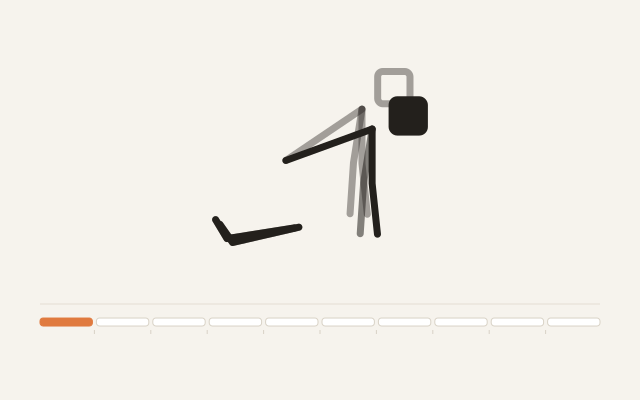
Cat and cow
Cat and cow
Holding · both sides
15:00
1 / 10
Six slow rounds, smaller than you think you need. This is the warm-up for everything that follows.
10 steps · 15 min

Before you start
General movement information, not medical advice. If a step produces pain rather than a stretch, stop the sequence and start your day; get persistent symptoms assessed rather than working around them.
Step table
StepHoldSideWhat you should feel
1. Cat and cow85s + 5sboth sidesSix slow rounds, smaller than you think you need. This is the warm-up for everything that follows.
2. Downward dog85s + 5sboth sidesKnees well bent, heels pedalling, spine long. In the morning this is a spine position, not a hamstring stretch — take it that way.
3. Standing forward fold85s + 5sboth sidesSoft knees, head heavy, hands on the floor or the shins. Roll up one vertebra at a time when the step ends.
4. Low lunge85s + 5sleft sideLeft foot forward, right knee down, tailbone tucked, right glute squeezed at 30%. Hands on the floor or on two bricks.
5. Low lunge85s + 5sright sideRight foot forward. Keep the chest lifted and the lower back long rather than arching to find more depth.
6. Seated thoracic rotation85s + 5sboth sidesSit tall, hands crossed on the chest, turn each way four times. The hips stay forward the whole time — the turn happens above them.
7. Glute bridge85s + 5sboth sidesFeet down, lift the hips eight times. This is the first thing all morning that asks anything of the body, and it should feel easy.
8. Thread the needle85s + 5sleft sideLeft arm under, right hand reaching. Rotation after the bridge — the body is warm now, so the range should be better than it was ten minutes ago.
9. Supine twist85s + 5sright sideKnees to the right, arms wide, left shoulder heavy. Slow breaths, and let the legs come back through centre by themselves.
10. Supine full stretch85s + 5sboth sidesArms overhead, legs long, stretch everything for five seconds and release. Three rounds, then lie still for a few breaths before you get up.

How to run this sequence

The order is the whole design

Each step is a smaller preview of something that comes later:

  • Cat and cow moves the spine through both directions before any of them is loaded.
  • Downward dog and the standing fold take the back line through a longer range while the body is still cold, so they stay short and are repeated later at a bigger range.
  • The lunges and the seated rotation come in the middle, once the spine and hips have both been moved.
  • The bridge, the twist and the full stretch finish it lying down, which is deliberate: you should end the sequence on the floor, not standing up wondering what happened.

The morning caveat, again

The spine holds more fluid in the first hour after waking and is measurably less tolerant of end-range bending. That is why nothing here asks for a deep forward fold with straight legs or a large twist in the first three minutes. If you have been awake less than twenty minutes, run the first four steps at two-thirds of the range you think you have. There is no prize for the deepest fold of the day and the cost of getting it wrong in the morning is higher than at any other time.

What to do if you only have five minutes

Run the cat and cow, the downward dog and the supine twist. Those three cover the spine in both directions, the back line, and rotation, and they are the three that make the rest of the day feel different. Doing one step properly beats rushing ten, and the sequence is written so that the individual steps stand on their own.

Questions about this sequence

Should I eat first?

Nothing here requires fuel and nothing here is intense enough to upset an empty stomach. If you are hungry, eat something small afterward rather than before — a full stomach makes the folded positions genuinely unpleasant.

Can I run this after a shower?

Yes, and it is easier, because the tissue is warmer. What you lose is the specific benefit of arriving at the day with a spine that has been moved rather than one that has been still and then washed.

Is it better than an evening session?

They do different jobs. Morning work changes how the day feels; evening work changes how you sleep and how much range persists into the next morning. If you can only do one, morning is the higher-value slot for most people who sit for a living.

Other sequences that pair well

Fifteen Minute 90/90 Hip Flow — Preview rail

Fifteen Minute 90/90 Hip Flow

15 min10 stepsStandardHips

The 90/90 position puts both hips at a right angle at the same time, which is the one shape that trains internal and external rotation together rather than one after the other. This sequence builds from the basic switch into the positions that use it — pigeon, lunge, frog — and back, with a glute bridge in the middle to make sure the hip is still doing work rather than only being stretched.

Ten Minute Desk Break, Whole Body — Preview rail

Ten Minute Desk Break, Whole Body

10 min8 stepsGentleFull body

This is the sequence to run when you have been still for too long and nothing in particular hurts. It touches every area in the order the body asks for them — spine, hips, legs, shoulders — and it uses only a chair and a wall, so there is no reason for it not to happen. It is deliberately gentle: the goal is to interrupt stillness, not to train.

Fifteen Minute Post-Run Calf and Hamstring — Preview rail

Fifteen Minute Post-Run Calf and Hamstring

15 min10 stepsStandardCalves & anklesHamstrings

The two muscles on the back of the leg are continuous in how they behave: a calf that tightens pulls on the hamstring through the pelvis, and a hamstring that will not lengthen makes the calf work harder on every stride. This sequence is built for after a run, when the tissue is warm and the sequence can afford to be specific. It starts at the ankle, moves up to the back of the knee, and finishes with the long line from the sit bone to the heel.